


Confused about UPSC optional subjects? Learn how to choose the best optional subject using syllabus analysis, GS overlap, PYQs, scoring trends and practical selection tips.
Choosing an optional subject is one of the most important decisions in the UPSC Civil Services Examination. It is also one of the decisions that creates the most confusion among aspirants. Some candidates select a subject because it is popular among toppers. Others follow their friends, choose the subject with the shortest syllabus, or believe that a particular optional is naturally more scoring.
However, there is no universally best optional subject for every UPSC aspirant.
The right subject is the one that matches your interests, academic strengths, learning style and preparation capacity. A subject that works exceptionally well for one candidate may become a difficult choice for another. For example, a student with a background in political science may find Political Science and International Relations (PSIR) familiar, while someone who enjoys understanding society and human behaviour may feel more comfortable with Sociology.
Your optional subject deserves careful attention because it contributes 500 marks to the UPSC Mains examination through two papers. A well-chosen subject can help you build conceptual clarity, develop a consistent answer-writing approach and improve your overall Mains preparation. A poorly chosen subject, on the other hand, can consume valuable time and create unnecessary pressure.
This guide explains how to choose the best UPSC optional subject using practical selection criteria, syllabus analysis, General Studies overlap, previous-year question papers, study resources and a structured decision-making framework. The aim is not to tell you which subject to select, but to help you identify the subject in which you can prepare confidently and perform consistently.
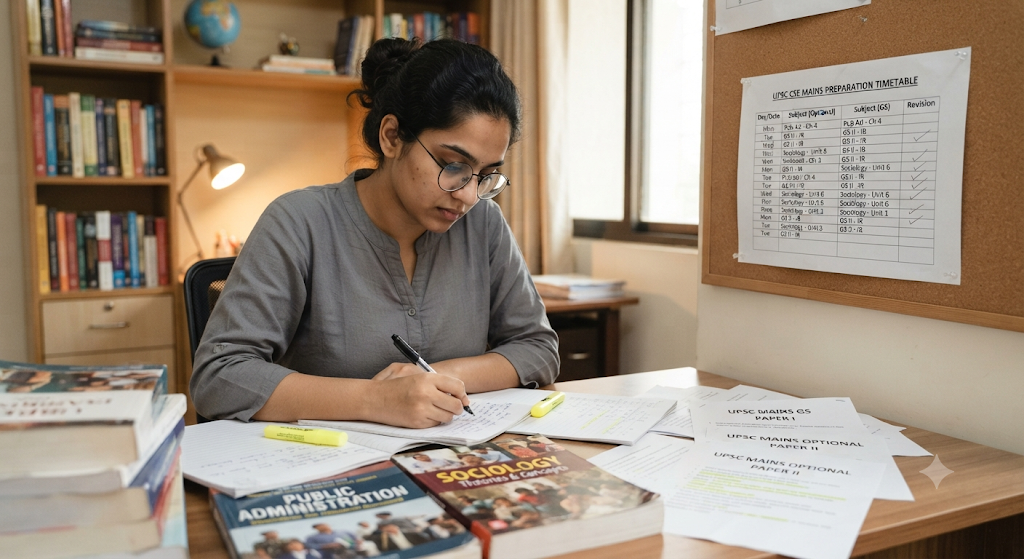
UPSC Optional Subjects: How to Choose the Best Optional Subject for Civil Services Mains
Choosing an optional subject is one of the most important decisions in the UPSC Civil Services Examination. It is also one of the decisions that creates the most confusion among aspirants. Some candidates select a subject because it is popular among toppers. Others follow their friends, choose the subject with the shortest syllabus, or believe that a particular optional is naturally more scoring.
However, there is no universally best optional subject for every UPSC aspirant.
The right subject is the one that matches your interests, academic strengths, learning style and preparation capacity. A subject that works exceptionally well for one candidate may become a difficult choice for another. For example, a student with a background in political science may find Political Science and International Relations (PSIR) familiar, while someone who enjoys understanding society and human behaviour may feel more comfortable with Sociology.
Your optional subject deserves careful attention because it contributes 500 marks to the UPSC Mains examination through two papers. A well-chosen subject can help you build conceptual clarity, develop a consistent answer-writing approach and improve your overall Mains preparation. A poorly chosen subject, on the other hand, can consume valuable time and create unnecessary pressure.
This guide explains how to choose the best UPSC optional subject using practical selection criteria, syllabus analysis, General Studies overlap, previous-year question papers, study resources and a structured decision-making framework. The aim is not to tell you which subject to select, but to help you identify the subject in which you can prepare confidently and perform consistently.
1. Understand the Importance of an Optional Subject Before Choosing One
Before comparing subjects, understand how the optional subject fits into the UPSC examination structure.
The Civil Services Mains examination includes Essay, four General Studies papers, two optional subject papers and qualifying language papers. The optional subject consists of two papers, each carrying 250 marks. Together, they account for 500 marks, which makes the optional a significant part of the written examination.
This is why optional selection should not be treated as a small decision that can be made casually. It requires the same attention that you give to your overall preparation strategy.
Why does your optional subject matter so much?
There are several reasons.
1. It contributes substantially to your Mains score
Your optional marks can influence your overall written score. Strong performance in the optional can support your final result, while weak preparation may reduce your chances of achieving a competitive score.
2. It requires specialised knowledge
General Studies covers a wide range of subjects, but optional papers demand deeper knowledge of a particular discipline. You may need to understand theories, thinkers, technical concepts, historical interpretations, diagrams, case studies or subject-specific terminology.
For example, a Sociology candidate may need to explain social stratification, social mobility and the theories of important sociologists. A Geography candidate may need to use geographical concepts, maps, diagrams and examples to support an answer.
3. It involves a different answer-writing approach
Writing a good General Studies answer and writing a good optional answer are not always the same thing.
In General Studies, you generally need to provide a balanced answer covering multiple dimensions. In an optional paper, examiners expect a deeper understanding of the subject. Your answer should demonstrate conceptual clarity, relevant terminology, analytical thinking and an understanding of the discipline.
4. It needs regular revision
Optional preparation is not something that can be completed once and forgotten. You need repeated revisions, question practice and periodic evaluation. Selecting a subject that genuinely interests you makes this process easier to sustain.
Can you choose an optional subject outside your graduation stream?
Yes. Your graduation subject does not restrict you to the same optional subject.
For example:
-
An engineering graduate can choose Sociology.
-
A commerce graduate can choose Political Science and International Relations.
-
A science graduate can choose Public Administration.
-
An arts graduate can choose Mathematics if they have the required aptitude and preparation capacity.
The UPSC’s official examination guidance confirms that candidates can select an optional subject they have not studied at the graduate or postgraduate level. However, the fact that a subject is available to you does not automatically mean it will be the right choice.
You should always examine the official syllabus and the examination rules for the relevant year before finalising your subject. The UPSC website is the primary source for current examination notices and subject-related information.
The biggest mistake: Looking for a universally best optional
A common question among aspirants is, “Which is the best optional subject for UPSC?”
The more useful question is, “Which optional subject can I understand, revise and write about effectively over a long preparation period?”
A subject that is considered scoring by one coaching institute may not suit your interests or learning style. Similarly, a subject with a large syllabus may be manageable for someone who enjoys it.
Therefore, do not begin your decision by asking which subject is easiest. Begin by identifying the subject in which you have the strongest combination of interest, aptitude, available resources and answer-writing potential.
2. Evaluate the Most Important Criteria for Selecting Your UPSC Optional
The best way to select an optional is to evaluate it through multiple factors rather than relying on a single recommendation.
Your academic background is useful, but it should not be the only deciding factor. Personal interest, subject aptitude, syllabus structure, learning resources and the ability to write analytical answers are equally important.
Let’s examine each factor in detail.
A. Personal interest: Choose a subject you can study consistently
Personal interest is one of the most important parts of optional selection.
UPSC preparation is a long process. You may need to study the same concepts several times, read standard books, solve previous-year questions and revise your notes. If you find the subject boring, maintaining consistency can become difficult.
Consider two candidates.
Candidate A selects Geography because it is popular among aspirants. However, they do not enjoy physical geography, climatology or geographical theories. They find the subject difficult to revise and gradually lose interest.
Candidate B selects Sociology because they enjoy understanding social relationships, inequality, family structures, social change and institutions. Although they have no formal background in Sociology, they find the concepts interesting and are willing to study them regularly.
Candidate B may have a more sustainable preparation experience because the subject matches their natural curiosity.
To test your interest, ask yourself:
-
Do I enjoy reading about this subject?
-
Am I curious about its theories and concepts?
-
Can I study it for two or three hours without feeling completely disconnected?
-
Do I naturally try to understand its real-world applications?
-
Will I be comfortable revising the same material multiple times?
Do not confuse temporary excitement with genuine interest. Watch lectures, read introductory chapters and examine actual UPSC questions before making your decision.
B. Academic background: Use your previous knowledge wisely
Your graduation subject can provide a useful starting point.
A candidate who has studied Political Science may already understand political institutions, constitutional concepts and international relations. Someone with a history degree may be familiar with historical sources, chronology and historical interpretation.
This previous knowledge can reduce the initial learning burden.
However, academic background should be treated as an advantage, not a compulsory selection rule.
For instance, a candidate who studied engineering may have strong analytical skills but may not want to continue studying technical subjects. They may prefer Anthropology, Sociology or Public Administration.
Similarly, a graduate in History may discover that they are more interested in Psychology or Philosophy.
Evaluate your academic background through these questions:
-
Which subjects did I perform well in during graduation?
-
Which subjects did I genuinely enjoy studying?
-
Do I still remember the basic concepts?
-
Would my previous knowledge help me understand advanced topics?
-
Am I comfortable studying this subject at a deeper level?
If you have already studied a subject, examine whether your knowledge is relevant to the current UPSC syllabus. University-level knowledge and UPSC optional preparation are not identical. You will still need to understand the prescribed syllabus, examination requirements and answer-writing expectations.
C. Subject aptitude: Understand how you learn
Aptitude refers to your natural ability to understand and work with a particular type of information.
Different optional subjects demand different learning approaches.
For example:
-
Geography involves spatial understanding, physical processes, maps, diagrams and analytical explanations.
-
History requires chronology, interpretation, factual knowledge and the ability to explain historical developments.
-
Sociology involves conceptual understanding, theories, thinkers and the application of ideas to social issues.
-
Mathematics requires logical reasoning, accuracy, regular problem-solving and strong conceptual foundations.
-
PSIR requires political theory, constitutional understanding, international relations and analytical writing.
-
Anthropology combines human evolution, biological concepts, social and cultural anthropology, and the study of communities.
A subject may look attractive on paper but may not match the way you learn best.
If you enjoy solving numerical problems, a technical or mathematical optional may be worth exploring. If you enjoy reading, analysing social issues and presenting arguments, a humanities subject may feel more natural.
The key is to identify your strengths rather than copy someone else’s preparation style.
D. Syllabus length and complexity: Look beyond the number of topics
Many aspirants choose an optional based on the belief that a shorter syllabus automatically means easier preparation.
This is not always true.
A subject may have fewer topics but require deeper conceptual understanding. Another subject may have a longer syllabus but offer a clear structure and predictable connections between topics.
A proper UPSC optional subject syllabus analysis should consider four dimensions:
| Factor | What you should examine |
|---|---|
| Syllabus length | Number of topics, subtopics and prescribed areas |
| Conceptual complexity | Difficulty of understanding theories, processes and technical concepts |
| Factual requirements | Amount of data, examples, thinkers, dates and terminology to remember |
| Revision requirements | Time needed to revise the subject and retain important concepts |
For example, Mathematics may have a defined syllabus, but candidates need considerable practice to develop accuracy and speed. History contains a broad range of historical developments, but candidates who enjoy reading and chronology may find it manageable.
Sociology is often perceived as a compact optional. However, candidates still need to understand sociological thinkers, apply theories and connect concepts with contemporary Indian society.
Therefore, do not judge a subject only by how many pages its syllabus contains.
E. Availability of study material, guidance and test series
Study resources are another important consideration.
Before selecting an optional, check whether you can access:
-
Standard textbooks and reference books.
-
Reliable notes and topic-wise study material.
-
Previous-year question paper solutions.
-
Subject-specific answer-writing guidance.
-
Quality test series and evaluation.
-
Mentorship or doubt-clearing support, if required.
-
Resources in your preferred language or medium.
A subject may interest you, but if reliable resources are difficult to find in your preferred medium, preparation may become more challenging.
This does not mean that you must select a subject simply because many coaching institutes teach it. Instead, check whether the available resources are accurate, syllabus-oriented and useful for independent preparation.
Also remember that coaching is not compulsory for every candidate. Some aspirants prepare successfully through standard books, self-made notes, previous-year questions and regular answer-writing practice.
The important thing is to have a dependable preparation system.
F. Answer-writing comfort: Can you explain concepts clearly?
Your ability to write effective answers is a major part of optional preparation.
A good optional answer should demonstrate that you understand the question, know the relevant concepts and can present a logical explanation within the available time.
Some subjects require diagrams, maps, equations or technical illustrations. Others demand the use of thinkers, theories, examples and critical arguments.
For example:
-
A Geography answer may become clearer with a labelled diagram or map.
-
A Sociology answer may benefit from a relevant thinker, concept and contemporary example.
-
A History answer may require chronological clarity and historical interpretation.
-
A PSIR answer may need theoretical arguments supported by constitutional or international examples.
Before finalising a subject, attempt a few basic questions from its syllabus. Check whether you can understand what the question demands and construct a meaningful answer.
If you enjoy the process of explaining concepts, you may be more comfortable with that subject over the long term.
3. Understand General Studies Overlap and Compare Popular Optional Subjects
One of the most common selection strategies is to choose an optional subject that overlaps with the General Studies syllabus.
This can be helpful because some concepts appear in both optional papers and GS papers. Studying them together may improve your understanding and reduce duplication.
However, UPSC optional subjects and General Studies syllabus overlap should be treated as a supporting factor, not the main selection criterion.
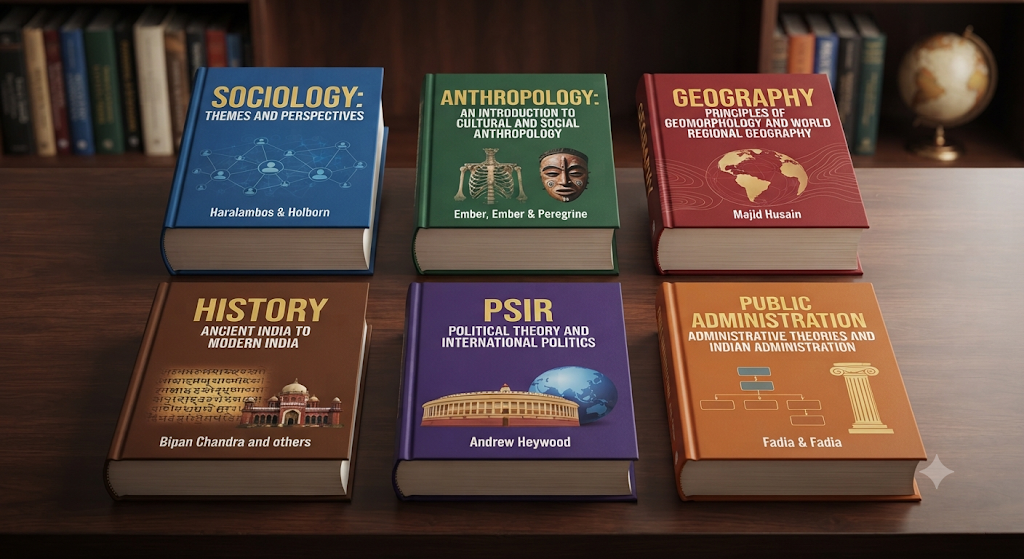
How optional subjects overlap with General Studies
Different subjects have connections with different GS papers.
| Optional subject | Possible overlap with GS | Areas of connection |
|---|---|---|
| Sociology | GS-I, Essay | Indian society, social issues, social change, inequality |
| Geography | GS-I, GS-III | Physical geography, resources, environment, agriculture and disasters |
| History | GS-I, Essay | Ancient, medieval and modern Indian history, culture and freedom struggle |
| PSIR | GS-II, Essay | Constitution, political institutions, governance and international relations |
| Public Administration | GS-II, GS-IV | Governance, administration, accountability and public service values |
| Anthropology | GS-I, Essay | Tribal communities, social institutions, culture and human development |
The overlap can be useful in several ways.
First, it can support integrated preparation. When you study a topic in your optional, you may develop a deeper understanding of a related GS topic.
Second, it can strengthen your Essay preparation. Subjects such as Sociology, PSIR, History and Philosophy can provide perspectives, concepts and examples that may be useful when writing essays.
Third, it can improve conceptual understanding. Studying a subject from both a general and specialised perspective can help you develop a more complete understanding of the topic.
However, there is an important limitation: overlap does not mean that the same preparation is sufficient for both papers.
For example, studying Indian Polity for GS-II does not automatically complete PSIR Paper I. Similarly, studying Indian society for GS-I does not cover the full Sociology optional syllabus.
Optional papers demand greater depth, subject-specific terminology and a more specialised approach.
Why GS overlap should not be your only selection criterion
Imagine that you are comparing Sociology and Geography.
You may discover that Sociology overlaps with Indian society topics in GS-I, while Geography connects with physical geography, resources, environment and agriculture.
Both offer useful overlap, but the right choice depends on your aptitude and interest.
If you dislike sociological theories, selecting Sociology only for GS overlap may create problems. If you struggle with maps, physical processes and geographical concepts, Geography may not be the right choice simply because it supports several GS topics.
A good optional should be independently strong for you. GS overlap should provide an additional advantage.
Popular UPSC optional subjects: A practical comparison
Let’s examine six popular subjects that many aspirants consider.
1. Sociology
What it covers: Sociology studies society, social relationships, institutions, social change, inequality and human behaviour.
Important areas include sociological thinkers, social stratification, family, religion, caste, class, social movements and Indian society.
Who may find it suitable?
-
Candidates interested in social issues and human behaviour.
-
Aspirants who enjoy reading conceptual and analytical material.
-
Candidates who want to connect academic ideas with contemporary examples.
-
Students from any academic background who are comfortable with theory-based study.
Potential advantages:
-
Useful connections with GS-I and Essay.
-
Concepts can be connected with current social developments.
-
Offers opportunities to use thinkers and examples in answers.
Potential challenges:
-
Requires a clear understanding of sociological theories.
-
Candidates must avoid writing general opinions instead of sociological analysis.
-
Thinkers, concepts and contemporary examples require regular revision.
2. Anthropology
What it covers:Anthropology is the study of human beings, their evolution, biological characteristics, cultures and social organisation.
Its syllabus includes physical and biological anthropology, human evolution, genetics, social anthropology, tribal communities and Indian anthropology.
Who may find it suitable?
-
Candidates interested in human evolution and cultural diversity.
-
Aspirants who enjoy a combination of scientific and social concepts.
-
Students who prefer structured topics and diagram-based explanations.
Potential advantages:
-
Includes clearly identifiable subject areas.
-
Diagrams and illustrations can improve answer presentation where relevant.
-
Certain topics connect with tribal issues and Indian society.
Potential challenges:
-
Biological anthropology may be unfamiliar to candidates without a science background.
-
Technical terminology requires careful understanding.
-
Both biological and social dimensions need balanced preparation.
3. Geography
What it covers: Geography studies the physical environment, human geography, resources, population, economic activities and spatial relationships.
Important areas include geomorphology, climatology, oceanography, population, settlement, agriculture, industries and Indian geography.
Who may find it suitable?
-
Candidates interested in maps, locations and environmental processes.
-
Aspirants who enjoy diagrams and spatial explanations.
-
Students with a background in geography or related subjects.
-
Candidates comfortable with both conceptual and factual learning.
Potential advantages:
-
Connections with GS-I and GS-III.
-
Maps and diagrams can support explanations.
-
Many topics have practical links with current affairs.
Potential challenges:
-
The syllabus is broad.
-
Physical geography requires conceptual clarity.
-
Map practice and regular revision are important.
4. History
What it covers:History focuses on the development of human societies, political systems, cultures, economies and major historical events.
The UPSC syllabus includes ancient, medieval and modern Indian history, world history and relevant historical developments.
Who may find it suitable?
-
Candidates who enjoy reading historical developments.
-
Aspirants interested in culture, society and political change.
-
Students comfortable with chronology, historical sources and interpretation.
Potential advantages:
-
Strong connection with GS-I.
-
Provides useful examples for Essay writing.
-
Helps develop an understanding of the historical background of modern institutions and society.
Potential challenges:
-
The syllabus covers a wide range of periods and themes.
-
Factual details require organised revision.
-
Good answers need analysis, not just a list of dates and events.
5. Political Science and International Relations (PSIR)
What it covers: PSIR includes political theory, political thinkers, Indian government and politics, comparative politics and international relations.
It examines political institutions, constitutional ideas, ideologies, international organisations, foreign policy and global developments.
Who may find it suitable?
-
Candidates interested in politics, governance and international affairs.
-
Aspirants who enjoy analytical reading and argument development.
-
Students interested in constitutional concepts and political theory.
Potential advantages:
-
Significant connections with GS-II.
-
International relations topics can support current affairs preparation.
-
Political theory and governance concepts can provide useful perspectives for Essay writing.
Potential challenges:
-
Requires clarity about political thinkers and theories.
-
International relations preparation needs regular updates.
-
Answers should balance theoretical understanding with contemporary examples.
6. Public Administration
What it covers:Public Administration studies administrative systems, public organisations, governance, accountability, public policy and administrative behaviour.
It examines how governments function and how public institutions deliver services.
Who may find it suitable?
-
Candidates interested in governance and administration.
-
Aspirants who enjoy understanding government institutions and public policies.
-
Students who prefer connecting concepts with practical administrative examples.
Potential advantages:
-
Connections with GS-II and GS-IV.
-
Relevant to governance, accountability and public service delivery.
-
Offers opportunities to use contemporary administrative examples.
Potential challenges:
-
Requires a clear understanding of administrative thinkers and concepts.
-
Some topics may appear familiar from GS but demand deeper optional-level analysis.
-
Answers should use relevant administrative terminology rather than generic statements.
Quick comparison of six popular subjects
| Subject | Broad learning style | Useful GS connection | A key challenge |
|---|---|---|---|
| Sociology | Conceptual and analytical | GS-I, Essay | Applying theories correctly |
| Anthropology | Scientific and social | GS-I, Essay | Biological and technical concepts |
| Geography | Conceptual, spatial and diagram-based | GS-I, GS-III | Broad syllabus and map practice |
| History | Factual and analytical | GS-I, Essay | Coverage and revision |
| PSIR | Theoretical and analytical | GS-II, Essay | Thinkers and current affairs |
| Public Administration | Conceptual and application-based | GS-II, GS-IV | Subject-specific analysis |
This comparison is only a starting point. It is not a ranking of subjects. The difficulty of a subject depends on your background, learning style and preparation approach.
Also, do not ignore other optional subjects. The official UPSC list includes disciplines such as Economics, Philosophy, Psychology, Law, Mathematics, Commerce and Accountancy, Medical Science, Engineering subjects and Literature options. A less popular subject may still be the best choice for a candidate with the right interest and preparation background.
4. Analyse Previous-Year Questions, Scoring Trends and Answer-Writing Requirements
After shortlisting two or three subjects, move beyond opinions and examine actual examination material.
This is where many aspirants make a major mistake. They compare coaching advertisements, topper interviews and online discussions but do not spend enough time reading the questions UPSC has actually asked.
A more reliable approach is to study the syllabus and previous-year question papers together.
A. Analyse 5–10 years of previous-year questions
Previous-year questions (PYQs) provide valuable insight into the nature of an optional subject.
They help you understand:
-
Which syllabus areas are repeatedly tested.
-
Whether questions are direct, analytical or application-based.
-
How topics are connected across different sections.
-
Whether current examples are useful in answers.
-
How much conceptual depth is expected.
-
Whether you can understand the language and demand of the questions.
Ideally, analyse five to ten years of available question papers for each shortlisted subject.
You do not need to solve every question immediately. Begin by organising the questions topic-wise.
For example, while analysing Sociology PYQs, you can create categories such as:
-
Sociological thinkers.
-
Research methods.
-
Social stratification.
-
Family and kinship.
-
Religion and society.
-
Social change.
-
Caste and class in India.
-
Social movements.
For Geography, you may create categories such as physical geography, human geography, Indian geography, resources, population and regional development.
This exercise helps you understand the actual structure of the subject.
B. Use a simple PYQ analysis method
Follow these steps:
Step 1: Download the official question papers
Use the UPSC website to access previous Civil Services Mains question papers. The official examination pages provide question papers for General Studies and optional subjects. For example, the UPSC Civil Services (Main) Examination 2026 page includes the available question-paper section.
Step 2: Match each question with the syllabus
Identify the exact syllabus topic connected with each question. This helps you understand how UPSC converts syllabus statements into examination questions.
Step 3: Identify recurring themes
Look for topics that appear repeatedly, either directly or through different dimensions.
Step 4: Examine question wording
Notice words such as:
-
Discuss
-
Examine
-
Critically analyse
-
Evaluate
-
Compare
-
Explain
-
Illustrate
These words indicate the type of response expected.
Step 5: Attempt a few questions
Choose some questions from different syllabus areas and try writing answers. This is one of the best ways to test your comfort with the subject.
A subject may look interesting while reading a textbook but feel very different when you have to write a structured answer under time pressure.
C. Should you choose an optional based on scoring trends?
Many aspirants search for the highest-scoring UPSC optional subject.
They want to know whether Sociology, Anthropology, Geography, PSIR or Public Administration produces better marks.
This is understandable because candidates naturally want to make a decision that improves their chances of success. However, UPSC optional subject scoring trends need to be interpreted carefully.
You may find online claims about:
-
Optional-wise success rates.
-
Average marks obtained by candidates.
-
Highest marks in a particular year.
-
Number of candidates scoring above a particular range.
-
Topper performance in different optional subjects.
These statistics may offer background information, but they do not provide a reliable prediction of your individual result.
There are several reasons.
First, the number of candidates differs between subjects. A subject with fewer candidates may show a different success rate from a subject with a much larger candidate pool.
Second, candidate preparation levels vary. People choosing a particular subject may have different academic backgrounds, preparation time and levels of subject familiarity.
Third, marks can vary across examination cycles. A subject’s perceived scoring trend in one year does not guarantee similar results in another year.
Fourth, topper marks are not a universal benchmark. A high-scoring candidate may have years of subject knowledge, excellent answer-writing skills or a particularly effective preparation strategy.
Therefore, do not choose an optional only because someone scored very high in it.
Instead, use scoring information as one secondary input. Your primary focus should remain on your ability to understand the syllabus, answer PYQs and prepare consistently.
D. Develop a subject-specific answer-writing strategy
Once you have selected an optional, your answer-writing strategy should match the nature of the discipline.
A common mistake is to use the same writing style for every optional subject.
For example, a Sociology answer may require theoretical interpretation, while a Geography answer may become more effective through diagrams and spatial examples.
A good UPSC optional subject answer-writing strategy should include the following elements.
1. Understand the exact demand of the question
Read the question carefully. Identify the topic, directive word and scope. Avoid writing everything you know about a subject.
2. Use relevant concepts and terminology
Every discipline has its own language. Use subject-specific terms correctly and explain them where necessary.
3. Build a logical structure
A clear introduction, organised body and relevant conclusion make your answer easier to follow.
4. Add examples and evidence
Examples can make abstract concepts easier to understand. Use relevant case studies, thinkers, data, events or practical illustrations where appropriate.
5. Practise diagrams, maps and tables where useful
These tools are especially relevant in subjects where visual representation adds clarity. Do not add diagrams simply to decorate an answer.
6. Include critical analysis
Where a question asks you to evaluate or critically examine an issue, present more than one perspective. Explain the strengths, limitations and implications of the argument.
7. Respect the word limit and time available
A well-researched answer is not useful if you cannot complete it within the examination time. Regular timed practice is essential.
E. Use model answers carefully
Model answers can help you understand structure, presentation and the depth expected in a response.
However, avoid memorising entire model answers.
A better approach is to study them for:
-
Introduction techniques.
-
Use of definitions.
-
Conceptual explanations.
-
Relevant examples.
-
Diagrams and illustrations.
-
Critical analysis.
-
Conclusion writing.
Then practise writing your own answers.
Your goal should be to develop independent understanding rather than reproduce someone else’s notes.
5. Follow a Practical Decision Framework Before Finalising Your Optional
By this stage, you should have shortlisted two or three subjects based on interest, background, syllabus and resources.
Now you need a structured method to compare them.
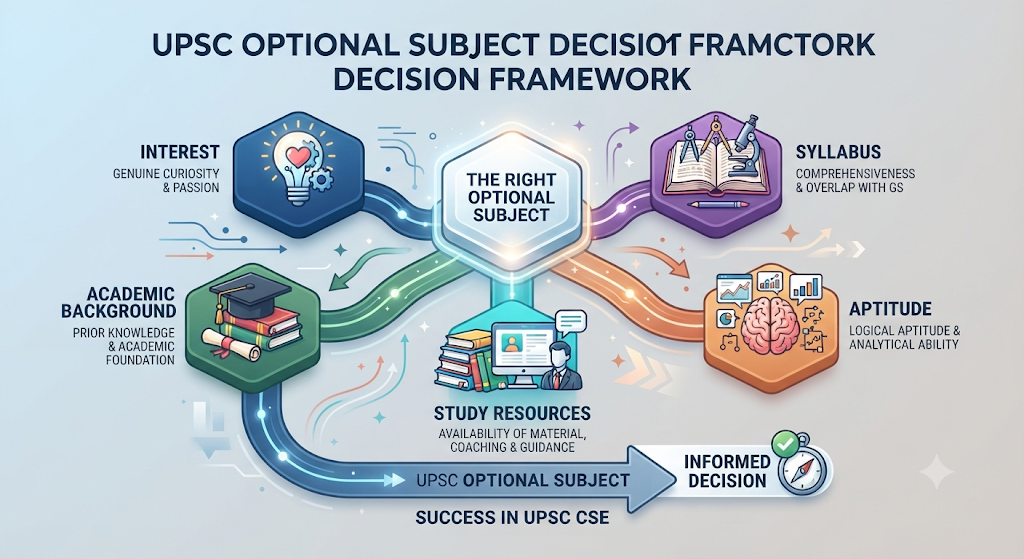
The following UPSC optional subject decision framework can help you make a more objective choice.
A. Create a comparative evaluation table
Give each shortlisted subject a score from 1 to 5 for the following factors:
| Selection factor | Weight | What to evaluate |
|---|---|---|
| Personal interest | 25% | How much you enjoy studying the subject |
| Subject aptitude | 20% | Your ability to understand its concepts |
| Syllabus manageability | 15% | Whether you can complete and revise it |
| PYQ comfort | 15% | How confidently you understand actual questions |
| Study resources | 10% | Availability of books, guidance and evaluation |
| GS overlap | 10% | Useful connections with GS and Essay |
| Answer-writing comfort | 5% | Your ability to present subject-specific answers |
The weights are a suggested personal evaluation model, not an official UPSC formula. You can adjust them according to your circumstances.
For example:
| Criteria | Sociology | Geography | PSIR |
|---|---|---|---|
| Personal interest | 5 | 3 | 4 |
| Subject aptitude | 4 | 3 | 4 |
| Syllabus manageability | 4 | 3 | 3 |
| PYQ comfort | 4 | 3 | 4 |
| Study resources | 5 | 5 | 5 |
| GS overlap | 4 | 5 | 5 |
| Answer-writing comfort | 4 | 3 | 4 |
These scores are only an illustration. They do not represent the actual difficulty, quality or scoring potential of any subject.
The purpose is to make your thinking more systematic. A subject with a slightly lower GS overlap score may still be a better option if you have greater interest and aptitude in it.
B. Conduct a seven-day trial study
One of the most practical ways to select an optional is to study each shortlisted subject for a few days.
Instead of relying only on opinions, test your own experience.
Here is a suggested seven-day approach:
| Day | Activity |
|---|---|
| Day 1 | Read the official syllabus of Subject A |
| Day 2 | Study two introductory chapters of Subject A |
| Day 3 | Examine PYQs and attempt one basic answer |
| Day 4 | Read the official syllabus of Subject B |
| Day 5 | Study two introductory chapters of Subject B |
| Day 6 | Examine PYQs and attempt one basic answer |
| Day 7 | Compare both subjects and evaluate your comfort level |
If you have a third subject in mind, extend the trial period.
During this process, observe your learning experience.
-
Which subject did you understand more easily?
-
Which one made you curious to read further?
-
Which syllabus appeared more manageable?
-
Which PYQs could you understand and attempt?
-
Which subject could you imagine revising several times?
Do not judge a subject only by the first chapter. Some subjects become easier after you understand their basic concepts.
C. Build your preparation timeline
Once you have selected your optional, create a realistic preparation timeline.
The exact duration depends on your background, available study hours, previous knowledge and the time remaining before your examination.
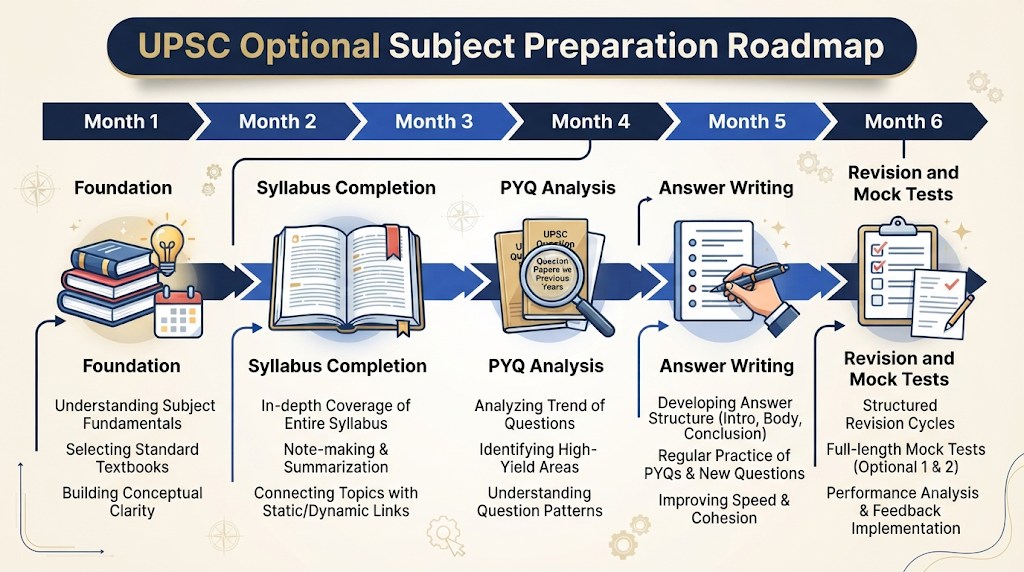
A possible six-month framework for a candidate who can devote consistent time to optional preparation is:
| Phase | Duration | Main activities |
|---|---|---|
| Phase 1: Foundation | Month 1 | Understand syllabus, read basic books and build concepts |
| Phase 2: First coverage | Months 2–3 | Complete major syllabus areas and prepare notes |
| Phase 3: PYQ integration | Month 4 | Link topics with previous-year questions and identify gaps |
| Phase 4: Answer writing | Month 5 | Practise timed answers and take sectional tests |
| Phase 5: Revision and testing | Month 6 | Revise notes, attempt mock papers and improve weak areas |
This is a planning example, not a guarantee that every candidate can complete every optional in six months. Technical subjects or unfamiliar disciplines may require a different schedule.
The most important principle is to begin answer-writing practice before you finish the entire syllabus. Waiting until the last month to write your first optional answer can create avoidable difficulties.
D. Avoid common optional selection mistakes
Even well-prepared candidates can make poor decisions when they follow popular opinions instead of evaluating their own needs.
Here are some mistakes to avoid.
Mistake 1: Choosing an optional only because a topper selected it
A topper’s success depends on several factors, including subject knowledge, preparation quality, answer writing and consistency. Their optional may not suit your strengths.
Mistake 2: Selecting a subject only because its syllabus appears short
A short syllabus can still be conceptually demanding. Examine the depth of the topics and the nature of the questions.
Mistake 3: Choosing based on coaching advertisements
Statements such as “highest scoring optional” or “guaranteed marks” should not decide your subject. Examine the syllabus and actual question papers instead.
Mistake 4: Ignoring previous-year questions
Reading introductory books without looking at PYQs can give you an incomplete picture of the subject.
Mistake 5: Overestimating General Studies overlap
Overlap is useful, but it does not replace optional-level preparation.
Mistake 6: Changing subjects repeatedly
Some aspirants change their optional after watching a few lectures or hearing negative opinions. This can waste months of preparation.
Make a reasonable decision after proper evaluation. Once you have selected a subject, give it sufficient time before considering a change.
Mistake 7: Ignoring the language and medium of preparation
Check whether you can access quality resources and express subject-specific ideas comfortably in your chosen examination medium. The UPSC provides guidance on examination languages and answer-writing rules, so review the relevant official instructions.
E. When should you change your optional subject?
Changing an optional is not automatically wrong, but it should be a carefully considered decision.
You may need to reconsider your selection if:
-
You discover that the subject is fundamentally different from what you expected.
-
You cannot understand its core concepts despite consistent effort.
-
You have a genuine mismatch between your aptitude and the subject’s demands.
-
Reliable preparation resources are not available in your preferred medium.
-
You identify another subject that is clearly more suitable after a proper trial.
However, do not change your subject merely because you received low marks in one test or found a particular chapter difficult.
Before making a change, identify the actual reason behind your difficulty. It may be a problem with your study method, revision schedule or answer-writing skills rather than the optional itself.
A decision made after systematic evaluation is better than a decision made under temporary pressure.
Conclusion: UPSC Optional Subjects How to Choose the Best Optional Subject
Choosing the best UPSC optional subject is a personal decision that should be based on evidence, self-awareness and realistic preparation planning.
There is no shortcut to making this decision. You need to understand the official syllabus, evaluate your interests, examine your academic background, assess your aptitude and compare the preparation requirements of different subjects.
Remember these key principles:
-
Select a subject that genuinely interests you.
-
Use your academic background as an advantage, not a restriction.
-
Analyse syllabus length, complexity and revision requirements.
-
Consider GS overlap, but do not make it your only selection criterion.
-
Study five to ten years of previous-year questions.
-
Treat scoring trends and topper marks as secondary information.
-
Check the availability of standard books, guidance and test series.
-
Practise subject-specific answer writing before finalising your decision.
-
Compare shortlisted subjects through a trial study and evaluation framework.
-
Once you make an informed choice, stay consistent with your preparation.
A popular optional is not necessarily the best optional. A subject with a short syllabus is not automatically an easy subject. And a subject that helped one candidate secure a high score may not produce the same result for someone with a different learning style.
Your objective should be to select a subject that you can understand deeply, revise repeatedly and present effectively in the examination.
Before finalising your UPSC optional, download the official syllabus, study previous-year questions and spend a few days exploring the subject. A thoughtful decision today can make your Mains preparation more organised and sustainable in the months ahead.
Start with your strengths, test your choices and select the subject you are prepared to master.
Important editorial note: The examination scheme and subject details should always be checked against the notification for the year in which you are appearing. The UPSC confirms that candidates may select an optional subject they have not studied at graduation or postgraduate level.
The official UPSC website also publishes Mains question papers, including optional papers, which are useful for your PYQ analysis.
FAQs: UPSC Optional Subjects How to Choose the Best Optional Subject
1. What is an optional subject in the UPSC Civil Services Examination?
An optional subject is a specialised subject selected by a candidate for the UPSC Mains examination. It consists of two papers, each carrying 250 marks, making a total of 500 marks.
2. How many optional subjects are available in UPSC?
UPSC offers a range of optional subjects across humanities, science, engineering, medical disciplines and literature. Candidates must select one optional subject from the list specified in the official examination notification.
3. Which is the best optional subject for UPSC?
There is no single best optional subject for everyone. The right choice depends on personal interest, academic background, subject aptitude, syllabus manageability, available resources and answer-writing ability.
4. How should I choose my UPSC optional subject?
Start by examining your interests and academic strengths. Then compare the official syllabuses, analyse previous-year questions, check study resources and attempt a few practice answers before finalising your subject.
5. Is an optional subject compulsory in UPSC Mains?
Yes. Candidates appearing for the UPSC Civil Services Mains examination must select one optional subject and appear for its two papers, subject to the applicable examination rules.
6. How many marks does the UPSC optional subject carry?
The optional subject carries 500 marks in total. Optional Paper I carries 250 marks, and Optional Paper II carries another 250 marks.
7. Can I choose an optional subject outside my graduation stream?
Yes. Candidates can select an optional subject even if they have not studied it during graduation or postgraduate studies. However, they should evaluate its syllabus and preparation requirements carefully.
8. Which optional subject has the shortest syllabus in UPSC?
Syllabus length can be interpreted differently depending on a candidate’s background and learning style. Rather than relying on claims about the shortest syllabus, compare the official syllabus, conceptual depth and revision requirements.
9. Is Sociology a good optional subject for UPSC?
Sociology can be a suitable option for candidates interested in society, social institutions, inequality, social change and human behaviour. It also has useful connections with GS-I and Essay preparation.
10. Is Anthropology a good optional subject for UPSC?
Anthropology may suit candidates who are interested in human evolution, biological anthropology, culture and tribal communities. It combines scientific and social concepts and requires an understanding of its specialised terminology.
11. Is Geography a good optional subject for UPSC?
Geography can be suitable for candidates interested in physical processes, maps, human geography, resources and environmental issues. It also has useful connections with GS-I and GS-III.
12. Is History a difficult optional subject for UPSC?
History can be demanding because of its broad syllabus and factual requirements. However, candidates who enjoy historical developments, chronology and interpretation may find it manageable with organised notes and regular revision.
13. Is PSIR a good optional for UPSC?
Political Science and International Relations (PSIR) may suit candidates interested in political theory, constitutional institutions, governance and international affairs. It also has substantial connections with GS-II.
14. Is Public Administration a good optional subject?
Public Administration can be a suitable choice for candidates interested in governance, administrative systems, public policy and accountability. Its concepts can also support parts of GS-II and GS-IV.
15. Which UPSC optional subject has the highest success rate?
Success rates vary across examination years and candidate groups. They should not be treated as a reliable prediction of individual performance. Choose your optional based primarily on aptitude, interest and preparation quality.
16. Which optional subject is most scoring in UPSC?
No subject guarantees higher marks. Scoring depends on conceptual clarity, syllabus coverage, answer quality, examination performance and the evaluation process.
17. Should I select an optional based on UPSC toppers?
Topper interviews can provide useful preparation insights, but copying their optional selection is not a reliable strategy. Evaluate whether the subject matches your own academic strengths and interests.
18. How important is GS overlap while choosing an optional?
GS overlap can reduce duplication and support integrated preparation. However, it should be a secondary factor because optional papers require deeper, subject-specific knowledge.
19. Which optional subject has the highest overlap with GS?
Different subjects overlap with different GS papers. PSIR connects with GS-II, Geography with GS-I and GS-III, Sociology with GS-I, and Public Administration with governance-related areas. No single subject covers all GS papers.
20. How much time is required to prepare a UPSC optional subject?
Preparation time depends on the subject, your background, available study hours and level of familiarity. Some candidates may need several months of focused study, revision and answer-writing practice.
21. Can I complete my optional subject in six months?
It may be possible with a structured schedule, consistent study and an appropriate preparation strategy. However, unfamiliar or technically demanding subjects may require more time.
22. How many hours should I study my optional subject daily?
There is no fixed number of hours for every candidate. Set a realistic daily target based on your overall preparation plan, syllabus coverage and revision requirements.
23. How many years of PYQs should I analyse before selecting an optional?
Analysing five to ten years of previous-year questions is a useful starting point. It helps you understand question patterns, recurring themes, conceptual depth and answer expectations.
24. Where can I download UPSC optional subject previous-year question papers?
You can download previous-year question papers from the official UPSC website under its examination and question-paper sections. Use official papers wherever possible.
25. Should I read the complete optional syllabus before choosing a subject?
Yes. Reading the complete syllabus is essential. It helps you understand the scope of the subject, identify unfamiliar areas and avoid making a decision based only on introductory topics.
26. Is coaching necessary for UPSC optional preparation?
No. Coaching is not compulsory. Candidates can prepare through standard textbooks, reliable study material, PYQs, self-made notes and regular answer-writing practice. Coaching may help those who need structured guidance.
27. How important are standard books for optional preparation?
Standard books provide conceptual foundations and reliable subject knowledge. Select resources according to the official syllabus and avoid collecting too many books for the same topic.
28. Should I choose an optional subject in English or Hindi medium?
Choose the medium in which you can understand concepts and express your ideas clearly. Also verify the applicable UPSC rules and the availability of reliable study resources in your preferred medium.
29. Can science students choose Sociology as their UPSC optional?
Yes. Science and engineering graduates can select Sociology if they find its concepts interesting and are prepared to study sociological theories and social issues.
30. Can commerce students choose PSIR as their optional?
Yes. Commerce graduates can select PSIR even without a formal academic background in political science. They should first explore political theory, Indian politics and international relations.
31. Is Mathematics a good optional for UPSC?
Mathematics may suit candidates with strong mathematical foundations and regular problem-solving ability. It requires conceptual accuracy, practice and effective time management.
32. Is Philosophy a good optional for UPSC?
Philosophy may suit candidates who enjoy abstract thinking, logic, ethics and philosophical arguments. A clear understanding of thinkers and concepts is essential.
33. How can I compare two UPSC optional subjects?
Compare personal interest, aptitude, syllabus size, conceptual complexity, PYQ comfort, study resources, GS overlap and answer-writing potential. A weighted evaluation table can make your decision more objective.
34. What is the best way to test an optional subject before selecting it?
Read the official syllabus, study introductory chapters, examine previous-year questions and attempt a few answers. A short trial study can reveal whether you are comfortable with the subject.
35. Should I change my optional subject after starting preparation?
Change your optional only after identifying a genuine mismatch. Do not switch merely because of one difficult topic, a disappointing mock-test score or another candidate’s opinion.
36. What are the most common mistakes in UPSC optional selection?
Common mistakes include copying toppers, choosing only by popularity, ignoring PYQs, overestimating GS overlap, underestimating syllabus complexity and changing subjects repeatedly.
37. How do I prepare notes for my optional subject?
Prepare syllabus-oriented notes using standard books, class material and PYQ themes. Keep definitions, theories, examples, diagrams and important arguments organised for quick revision.
38. How important is answer writing in optional preparation?
Answer writing is extremely important because it helps you apply knowledge under examination conditions. Practise structuring answers, using subject terminology and addressing the exact question demand.
39. When should I start optional answer-writing practice?
Start with basic answers after understanding the introductory concepts. Gradually increase the difficulty and practise timed answers as you cover more of the syllabus.
40. Are model answers useful for optional preparation?
Yes. Model answers can help you understand structure, presentation and analytical depth. However, use them as learning references rather than memorising them word for word.
41. Do diagrams improve UPSC optional answers?
Diagrams can improve answers when they communicate relevant information clearly. They are especially useful in subjects such as Geography and Anthropology, but should be used only where appropriate.
42. How many revisions are required for an optional subject?
There is no fixed number. Multiple revisions are generally necessary to retain concepts, theories, facts and examples. The number should depend on your preparation level and examination schedule.
43. Can I prepare my optional subject alongside General Studies?
Yes. Integrated preparation is useful when planned properly. However, optional preparation should receive dedicated time because its papers require greater subject-specific depth.
44. What should I prioritise: Optional or General Studies?
Both are important. Your timetable should provide consistent time for optional and GS preparation. The balance can change depending on your preparation stage and the examination calendar.
45. How does optional subject preparation help in Essay writing?
Optional preparation can provide theories, examples, historical perspectives and analytical frameworks that may strengthen essay arguments. However, you must still practise essay structure and coherent writing.
46. Is it better to choose a popular optional or a less popular optional?
Popularity should not determine your selection. A less popular subject can be a strong choice if it matches your interests, aptitude and preparation resources.
47. Can I select Literature as my UPSC optional subject?
Yes. UPSC provides various literature subjects in its optional subject list. Candidates should select a literature subject only if they have the required language knowledge and comfort with its prescribed syllabus.
48. What role do optional subject test series play?
Test series help evaluate answer quality, time management, syllabus coverage and presentation. They are useful when the evaluation is meaningful and aligned with the actual examination requirements.
49. What should I do after finalising my UPSC optional subject?
Read the complete syllabus, organise standard resources, analyse PYQs, prepare a study timetable, create revision notes and begin regular answer-writing practice.
50. What is the most important rule for choosing the best UPSC optional subject?
Choose a subject that you can understand deeply, study consistently, revise effectively and write about confidently. A thoughtful selection is more valuable than following temporary trends or popular recommendations.
