


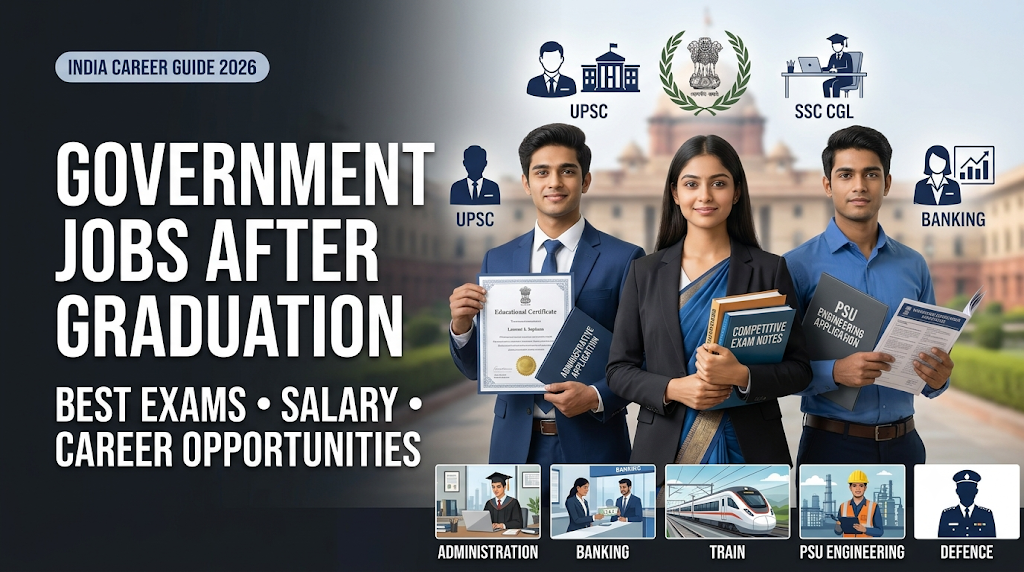
Government Jobs After Graduation Best Exams and Career Opportunities in India
Graduation is an important milestone in a student’s life. After completing a bachelor’s degree, many young people begin looking for career opportunities that offer financial stability, professional growth and the chance to contribute to society. In India, government jobs remain one of the most popular career choices because they can provide structured career progression, competitive salaries, job security and several employment benefits.
The good news is that a graduate has access to a wide range of government recruitment opportunities. Whether you have completed a BA, BCom, BSc, BTech, BBA, BCA or another recognised degree, there are several competitive examinations through which you can enter central government departments, public sector banks, railway services, regulatory institutions, insurance organisations and state administrative services.
Some candidates dream of becoming an IAS or IPS officer through the UPSC Civil Services Examination. Others prefer the SSC Combined Graduate Level Examination because it offers opportunities in central government departments. Graduates interested in finance and banking can explore IBPS PO, SBI PO and RBI recruitment, while engineering graduates may find suitable opportunities in public sector undertakings through GATE.
There are also career options in Indian Railways, state public service commissions, insurance companies, rural development institutions and defence services.
However, choosing the right examination is not always easy. Each recruitment process has different eligibility requirements, age limits, examination patterns, job responsibilities and salary structures. Preparing for several examinations without understanding their differences can waste valuable time and effort.
This guide explains the best government jobs after graduation in India, the major competitive examinations, the posts available, eligibility requirements, expected salary structures, selection procedures and preparation strategies. It will help fresh graduates and experienced candidates identify career opportunities that match their educational background, interests and long-term goals.
1. Best Government Exams After Graduation in India
India has several recruitment examinations for graduates. Some are conducted by national-level recruiting bodies, while others are organised by state governments, banks, railways and specialised institutions.
The most suitable examination depends on your academic background, preferred job profile, age, preparation level and career ambitions. Here are some of the most important government examinations graduates should know about.
1. UPSC Civil Services Examination (CSE)
The UPSC Civil Services Examination (CSE) is among the most prestigious competitive examinations in India. It is conducted by the Union Public Service Commission to recruit candidates for important administrative and government services.
Candidates who successfully clear the examination may be allocated services such as:
-
Indian Administrative Service (IAS)
-
Indian Police Service (IPS)
-
Indian Foreign Service (IFS)
-
Indian Revenue Service (IRS)
-
Other participating Group A and Group B services
An IAS officer may work in district administration, policy implementation, public welfare programmes and senior government positions. An IPS officer is responsible for police administration, law enforcement and internal security. Officers in the Indian Foreign Service represent India in international relations and diplomatic assignments, while IRS officers work in areas related to direct or indirect taxation.
Eligibility: A recognised bachelor’s degree or an equivalent qualification is generally required. Candidates from arts, commerce, science, engineering and other recognised academic backgrounds can apply, subject to the conditions in the notification.
The usual minimum age for the general category is 21 years. The upper age limit and permitted attempts depend on the candidate’s category and the applicable UPSC rules.
Selection process: The examination generally has three stages:
-
Preliminary Examination – objective-type papers used for screening candidates.
-
Main Examination – written descriptive papers assessing knowledge, analytical ability and written communication.
-
Personality Test – an interview to evaluate suitability for civil services.
The Preliminary Examination includes General Studies and the Civil Services Aptitude Test (CSAT). Candidates who qualify for the Mains examination must prepare a broader range of subjects, including the compulsory papers, essay, optional subject and other prescribed components.
Career opportunities: Civil servants can work in district administration, public policy, revenue administration, policing, diplomacy, social development and various central government departments.
The UPSC CSE is particularly suitable for graduates who are interested in public administration, governance, national development and leadership responsibilities.
It is also one of the most demanding examinations in India. Candidates should understand the syllabus, previous-year question papers and examination stages before committing to a long preparation plan.
2. SSC Combined Graduate Level (CGL) Examination
The Staff Selection Commission Combined Graduate Level (SSC CGL) Examination is one of the most popular options for graduates seeking central government jobs.
SSC conducts this examination to recruit candidates for different Group B and Group C posts in ministries, departments, offices and organisations under the Government of India.
Some important posts available through SSC CGL include:
-
Assistant Section Officer (ASO)
-
Income Tax Inspector
-
Central Excise Inspector
-
GST-related Inspector posts, as notified
-
Assistant Audit Officer, when included in the recruitment
-
Assistant Accounts Officer, when included
-
Auditor
-
Accountant
-
Tax Assistant
-
Other notified departmental positions
The exact posts and vacancies can change from one recruitment cycle to another.
Eligibility: A bachelor’s degree from a recognised university is generally required. Certain specialised posts may have additional educational or subject-related requirements. For example, some statistical posts require a relevant background in mathematics or statistics.
The age limit varies according to the post. Different positions may have different age brackets, and applicable relaxations are available to eligible categories under government rules.
Selection process: SSC CGL generally uses a computer-based examination conducted in multiple tiers. The examination structure, papers and qualifying requirements are specified in the relevant notification.
Candidates should prepare subjects such as:
-
General Intelligence and Reasoning
-
Quantitative Aptitude
-
English Comprehension
-
General Awareness
-
Statistics or other specialised subjects, where applicable
-
Computer-related knowledge and other prescribed components
Career opportunities: SSC CGL provides opportunities to work in central government offices, taxation departments, audit organisations, ministries and administrative establishments.
For example, an Income Tax Inspector may work in tax administration and related departmental activities. An Assistant Section Officer may handle official files, correspondence, administrative coordination and policy-related work.
SSC CGL is a practical option for graduates who want a central government career but are not necessarily interested in the extensive preparation required for the Civil Services Examination.
3. Banking Recruitment Examinations: IBPS PO, SBI PO and Clerk
Banking is another major career sector for graduates in India. Public sector banks recruit candidates for officer and clerical positions through competitive examinations.
The major recruitment examinations include:
-
Institute of Banking Personnel Selection Probationary Officer (IBPS PO)
-
State Bank of India Probationary Officer (SBI PO)
-
IBPS Customer Service Associate recruitment, commonly known as IBPS Clerk
-
SBI Customer Support and Sales recruitment, commonly known as SBI Clerk
These examinations provide opportunities to work in public sector banking institutions across India.
IBPS PO: The IBPS Probationary Officer examination is conducted for recruitment to participating public sector banks. Selected candidates generally begin their careers as probationary officers and receive training in banking operations, customer services, credit, account management and branch administration.
SBI PO: State Bank of India conducts its own recruitment examination for Probationary Officers. The role involves banking operations, customer relationship management, financial services, business development and administrative responsibilities.
IBPS and SBI Clerk: Clerical-level recruitment provides opportunities to work in customer-facing and operational roles. Responsibilities may include account-related services, cash transactions, documentation, customer assistance and other branch operations.
Eligibility: A bachelor’s degree in any discipline from a recognised university is generally required for these graduate-level recruitment examinations. Specific age limits, cut-off dates, nationality conditions and other requirements vary by recruitment cycle.
Selection process: The process usually includes some combination of:
-
Preliminary examination
-
Main examination
-
Interview for officer-level recruitment, where prescribed
-
Language proficiency test or other applicable assessments
-
Document verification and medical or fitness-related formalities, where required
Candidates should prepare reasoning ability, quantitative aptitude, English language, general and banking awareness, and computer knowledge according to the examination pattern.
Career opportunities: Banking careers can offer structured promotions and opportunities to move into branch management, credit operations, risk management, specialist functions and senior administrative positions.
Banking examinations are particularly suitable for graduates who enjoy working with numbers, financial services, customer interaction and business operations.
4. Reserve Bank of India (RBI) Recruitment
The Reserve Bank of India (RBI) is India’s central bank. It plays a major role in monetary policy, currency management, financial regulation, banking supervision and maintaining financial stability.
Working with RBI is an attractive career option for graduates interested in economics, finance, banking and public policy.
Two important recruitment opportunities are:
RBI Grade B Officer
RBI Grade B is a competitive officer-level recruitment examination. Selected officers may work in areas such as:
-
Banking regulation and supervision
-
Economic and financial research
-
Currency management
-
Financial markets
-
Monetary policy-related functions
-
Financial inclusion
-
Regulatory administration
The General stream is open to eligible graduates who satisfy the prescribed educational marks and other conditions. The 2026 notification, for example, specified minimum graduation marks and category-based relaxations. The DEPR and DSIM streams have separate specialised educational requirements.
RBI Assistant
RBI Assistant is a recruitment opportunity for candidates interested in administrative and clerical work within the central bank. Responsibilities may include office administration, document processing, data-related tasks and operational support.
The educational requirements, age criteria and selection stages are specified separately in the relevant recruitment notification.
Selection process: RBI Grade B generally involves Phase I, Phase II and an interview for the applicable stream. RBI Assistant recruitment generally includes preliminary and main examinations, followed by a language proficiency test where prescribed.
Career opportunities: RBI officers can develop careers in financial regulation, banking supervision, economic research, currency management and other central banking functions. RBI Assistant employees can gain experience in administrative and operational work.
RBI recruitment is highly competitive. Candidates should carefully study the official notification because the eligibility requirements for Grade B General, DEPR, DSIM and Assistant are not identical.
5. Railway Recruitment Board (RRB) NTPC Graduate-Level Examination
Indian Railways is one of the largest employers in the country. It offers various career opportunities for graduates through the Railway Recruitment Board (RRB) Non-Technical Popular Categories (NTPC) Graduate-Level Examination.
The recruitment covers non-technical positions in railway operations, commercial services, accounts and administration.
Important graduate-level posts may include:
-
Station Master
-
Goods Train Manager
-
Chief Commercial Cum Ticket Supervisor
-
Junior Accounts Assistant Cum Typist
-
Senior Clerk Cum Typist
The availability of individual posts depends on the recruitment notification.
Eligibility: Candidates generally need a recognised university degree. Certain positions, particularly those involving accounts or clerical work, may require typing proficiency or other prescribed skills.
Age limits and relaxations are determined by the relevant Centralised Employment Notification (CEN).
Selection process: Depending on the post and recruitment cycle, the process may include:
-
Computer-Based Test (CBT) Stage 1
-
Computer-Based Test (CBT) Stage 2
-
Computer-Based Aptitude Test or Typing Skill Test, where applicable
-
Document verification
-
Medical examination
For example, a Station Master recruitment process may include an aptitude test, while Junior Accounts Assistant Cum Typist and Senior Clerk Cum Typist positions may involve a typing skill test.
Career opportunities: Railway employees may work in station operations, train movement management, passenger services, commercial administration, accounts and office management.
RRB NTPC is a suitable option for graduates who want to work in the railway sector and are comfortable with operational, administrative or customer-facing responsibilities.
6. State Public Service Commission (State PSC) Examinations
Candidates who want to work in state administration should consider State Public Service Commission (State PSC) Examinations.
Every state has its own recruitment commission or designated recruiting authority for various administrative and departmental positions. Examples include the Uttar Pradesh Public Service Commission (UPPSC), Bihar Public Service Commission (BPSC), Rajasthan Public Service Commission (RPSC), Madhya Pradesh Public Service Commission (MPPSC) and other state commissions.
Depending on the state and recruitment notification, these examinations may recruit candidates for positions such as:
-
Deputy Collector
-
Deputy Superintendent of Police (DSP)
-
Block Development Officer (BDO)
-
Assistant Commissioner
-
State Tax Officer
-
Other state administrative and departmental posts
Eligibility: A recognised bachelor’s degree is generally required for many State Civil Services examinations. Some specialised posts may require additional qualifications or experience.
Age limits, domicile conditions, language requirements and reservation rules differ between states. Candidates should check the relevant commission’s notification before applying.
Selection process: Many State PSC examinations follow a three-stage process:
-
Preliminary Examination
-
Main Written Examination
-
Interview or Personality Test
The syllabus often includes Indian history, geography, polity, economy, general science, current affairs and state-specific general knowledge. Some examinations also include state language papers or other compulsory subjects.
Career opportunities: State civil servants may work in district administration, revenue departments, law enforcement, rural development, public welfare, state taxation and other government departments.
State PSC examinations are particularly suitable for candidates who want to serve in their home state or develop a career in regional administration.
One important consideration is that every state has a different syllabus and examination calendar. Candidates should avoid relying entirely on preparation material designed for another state’s examination.
7. Public Sector Undertaking (PSU) Recruitment Through GATE
Engineering graduates have specialised government career opportunities through Public Sector Undertaking (PSU) Recruitment through GATE.
Several government-owned organisations recruit engineering graduates for technical, executive and management-related positions. Depending on the organisation and recruitment year, GATE scores may be used as part of the selection process.
Important public sector organisations include:
-
Oil and Natural Gas Corporation (ONGC)
-
National Thermal Power Corporation (NTPC)
-
Bharat Heavy Electricals Limited (BHEL)
-
Steel Authority of India Limited (SAIL)
Other public sector organisations may also recruit candidates through GATE or their own recruitment procedures.
Eligibility: The requirements depend on the PSU, engineering discipline, degree type, qualifying marks and the applicable GATE paper. Common eligible disciplines may include mechanical, electrical, civil, electronics, chemical and computer-related engineering, depending on the vacancy.
Selection process: Recruitment may involve:
-
GATE score screening
-
Shortlisting based on the prescribed criteria
-
Interview or group discussion, where applicable
-
Document verification
-
Medical examination
Not every PSU uses GATE in every recruitment cycle. Some organisations conduct independent examinations or use different shortlisting methods.
Career opportunities: Selected candidates may work as graduate engineers, management trainees, technical officers or executives. Their responsibilities can include project execution, plant operations, engineering design, maintenance, production, research and technical management.
PSU recruitment is particularly suitable for engineering graduates who want to apply their technical knowledge in large infrastructure, energy, manufacturing and industrial organisations.
Before preparing, candidates should identify the PSUs that recruit from their engineering discipline and check whether they use GATE scores for the relevant year.
8. Insurance Sector Recruitment: LIC AAO, NIACL AO and GIC
The insurance sector offers another group of career opportunities for graduates.
Public sector insurance organisations recruit candidates for administrative, officer-level and specialist positions. Some of the important recruitment examinations include:
-
Life Insurance Corporation of India (LIC) Assistant Administrative Officer (AAO)
-
New India Assurance Company Limited (NIACL) Administrative Officer (AO)
-
General Insurance Corporation of India (GIC) recruitment
LIC AAO: The Assistant Administrative Officer role involves administrative operations, policy-related processes, coordination, customer service and other functions depending on the department and posting.
NIACL AO: Administrative Officers may work in insurance underwriting, claims management, policy administration, finance, accounts and related operations. Specialist positions may have separate educational requirements.
GIC recruitment: GIC periodically recruits officers for different disciplines. The required degree, professional qualification and experience depend on the post advertised.
Eligibility: Generalist officer positions may accept graduates from recognised universities, while specialist roles can require qualifications in areas such as law, finance, engineering, actuarial science or other relevant disciplines.
Selection process: Depending on the organisation and post, recruitment may include preliminary examinations, main examinations, interviews, document verification and medical requirements.
Career opportunities: Insurance officers can build careers in policy administration, risk assessment, underwriting, claims, financial management, customer service and departmental administration.
These opportunities are suitable for graduates interested in financial services and insurance operations. Candidates should compare the job responsibilities and specialist requirements before selecting an examination.
9. NABARD Grade A and Grade B Examinations
The National Bank for Agriculture and Rural Development (NABARD) is an important development financial institution in India. It works in areas related to agriculture, rural development, rural infrastructure and financial inclusion.
NABARD offers career opportunities for graduates interested in development finance, rural banking and agricultural economics.
Two important recruitment opportunities are:
NABARD Grade A – Assistant Manager
Grade A recruitment is conducted for Assistant Manager positions in notified disciplines or streams. Depending on the recruitment cycle, opportunities may be available in the Rural Development Banking Service and other specialist areas.
NABARD Grade B – Manager
Grade B recruitment is for Manager-level positions when notified. The number of vacancies and educational requirements depend on the recruitment advertisement.
Eligibility: Requirements vary by stream. Some posts may accept graduates in specified disciplines, while others require postgraduate degrees, professional qualifications or relevant experience. Candidates should not assume that every NABARD position is open to graduates from all academic backgrounds.
Selection process: The process may include:
-
Preliminary examination
-
Main examination
-
Interview
-
Document verification and other prescribed checks
The syllabus can include reasoning, quantitative aptitude, English, general awareness, economic and social issues, agriculture and rural development, and stream-specific subjects.
Career opportunities: NABARD officers may work in rural credit planning, agricultural finance, development programmes, institutional development, rural infrastructure and financial inclusion.
This career path is particularly suitable for candidates who have an interest in agriculture, economics, rural development and the financial needs of rural communities.
10. UPSC Combined Defence Services (CDS) and CAPF Assistant Commandant Examinations
Graduates who want a disciplined career involving leadership, public service and national security can explore defence and paramilitary officer recruitment.
Two important opportunities are the UPSC Combined Defence Services (CDS) Examination and the UPSC Central Armed Police Forces (CAPF) Assistant Commandant Examination.
Combined Defence Services (CDS)
The CDS examination is conducted by UPSC to recruit eligible candidates for officer training at specified defence academies.
Depending on the academy, candidates may pursue opportunities in:
-
Indian Military Academy (IMA)
-
Indian Naval Academy (INA)
-
Air Force Academy (AFA)
-
Officers Training Academy (OTA)
Educational requirements vary by academy. For example, certain academies require an engineering degree, while others accept a recognised bachelor’s degree. Air Force entry may have additional subject or technical conditions.
Candidates must also satisfy the applicable age, marital status, physical and medical standards.
The selection process generally involves a written examination followed by the Services Selection Board (SSB) interview and medical assessment.
CAPF Assistant Commandant
The CAPF Assistant Commandant examination is another UPSC recruitment opportunity for graduates.
It is conducted for officer-level positions in participating Central Armed Police Forces, which may include:
-
Border Security Force (BSF)
-
Central Reserve Police Force (CRPF)
-
Central Industrial Security Force (CISF)
-
Indo-Tibetan Border Police (ITBP)
-
Sashastra Seema Bal (SSB)
Candidates generally need a recognised bachelor’s degree and must meet the prescribed age and physical standards.
The selection process usually includes a written examination, physical standards and physical efficiency tests, interview or personality test, and medical examination.
These careers are suitable for graduates who are physically fit, disciplined and interested in security, leadership and operational responsibilities.
2. Eligibility Criteria for Government Jobs After Graduation
Although graduation is the basic requirement for many government examinations, the eligibility criteria are not identical across recruitment bodies.
A candidate who qualifies for SSC CGL may not automatically qualify for RBI Grade B, a specialised PSU position or a defence academy. Every examination has its own rules.
Understanding the main eligibility conditions before starting preparation can prevent application mistakes and help candidates choose suitable examinations.
Educational Qualification
Most graduate-level government examinations require a bachelor’s degree from a recognised university or an equivalent qualification.
However, the required educational background can differ:
-
Any graduate: UPSC CSE, SSC CGL and many banking examinations generally accept candidates from different academic streams, subject to notification conditions.
-
Engineering graduates: PSU recruitment through GATE often requires a degree in a specific engineering discipline.
-
Specialist graduates: Insurance, RBI, NABARD and other institutions may advertise posts requiring qualifications in finance, economics, law, statistics, agriculture or other specialised subjects.
-
Defence candidates: CDS academy eligibility depends on the specific academy and educational background.
Candidates in their final year should carefully check whether the examination permits them to apply. Some recruitments require the degree result to be declared by a specified date.
Age Limit
Age limits vary significantly across government examinations.
Some recruitment processes have a minimum age of 18 or 20 years, while others require candidates to be at least 21 years old. The upper age limit also differs according to the post and recruiting organisation.
For example, UPSC Civil Services, SSC CGL, banking examinations, RBI recruitment and defence examinations follow separate age criteria.
Government rules may provide upper-age relaxation to eligible categories, including:
-
Scheduled Castes (SC)
-
Scheduled Tribes (ST)
-
Other Backward Classes (OBC), as applicable
-
Persons with Benchmark Disabilities (PwBD)
-
Ex-servicemen
-
Other categories specifically mentioned in the notification
Age is calculated using the reference date specified in the recruitment advertisement. Candidates should not rely on a general age-limit chart without checking the applicable notification.
Nationality and Domicile Requirements
Many central government examinations require Indian citizenship, although certain notifications permit specified other nationality categories subject to conditions.
State-level recruitment may also include domicile requirements, local language conditions or state-specific reservation rules.
Candidates applying for State PSC examinations should carefully read the domicile and language provisions. Similarly, candidates applying for central government recruitment should check the nationality conditions in the official advertisement.
Physical and Medical Standards
Physical fitness is an important eligibility requirement for certain government careers.
For example, CDS, CAPF Assistant Commandant and some police or defence-related recruitment processes require candidates to satisfy prescribed physical and medical standards.
These may include:
-
Height requirements
-
Weight or body proportion standards
-
Chest measurements, where applicable
-
Physical efficiency tests
-
Medical fitness assessments
-
Vision and other medical standards
Physical requirements are not universal across all government jobs. A candidate applying for a desk-based administrative post may not face the same physical tests as a candidate applying for an armed or uniformed service.
Always check the specific standards for the post you want.
3. Government Job Salary, Benefits and Career Growth After Graduation
Salary is an important factor when choosing a government career, but it should not be the only consideration.
Different government organisations follow different pay structures. Central government posts may follow the applicable Pay Commission framework, while banks, financial institutions, public sector undertakings and insurance organisations may follow separate salary and allowance structures.
Your actual compensation can depend on the post, pay level, location, allowances, experience and applicable service rules.
Salary Structure Across Major Government Sectors
The following table provides a broad overview of the types of roles and salary structures candidates may encounter. It is not a guaranteed or current salary chart. Actual figures must be checked in the relevant recruitment notification.
| Examination or recruitment | Typical posts | Salary structure |
|---|---|---|
| UPSC Civil Services | IAS, IPS, IFS, IRS and other services | Government pay matrix and service-specific allowances |
| SSC CGL | ASO, Income Tax Inspector, Auditor and other posts | Central government pay levels according to post |
| IBPS PO / SBI PO | Probationary Officer | Bank officer pay scales and allowances |
| IBPS / SBI Clerk | Customer Service Associate or Clerk | Bank clerical pay scales and allowances |
| RBI Grade B | Grade B Officer | RBI-specific pay structure and benefits |
| RBI Assistant | Assistant | RBI-specific assistant pay structure |
| RRB NTPC Graduate | Station Master, Goods Train Manager and other posts | Railway pay levels and applicable allowances |
| State PSC | Deputy Collector, DSP, BDO and other posts | State government pay scales |
| PSU through GATE | Graduate Engineer, Executive and Trainee roles | Organisation-specific compensation |
| LIC AAO / NIACL AO / GIC | Administrative and specialist officers | Insurance organisation pay structure |
| NABARD Grade A / B | Assistant Manager and Manager | NABARD-specific pay and benefits |
| CDS / CAPF | Defence and Assistant Commandant officers | Applicable service pay, allowances and benefits |
Allowances and Other Benefits
In addition to basic pay, many government and public sector jobs may provide benefits such as:
-
Dearness Allowance (DA)
-
House Rent Allowance (HRA), where applicable
-
Transport or travel-related allowances
-
Medical facilities or medical reimbursement
-
Leave and paid holidays
-
Retirement benefits under applicable service rules
-
Provident fund or pension-related benefits, as applicable
-
Departmental accommodation, where available
-
Training and professional development opportunities
The actual benefits depend on the employer and service conditions. Not every benefit is available in every post.
For example, a central government employee, a public sector bank officer and an RBI officer may have different compensation structures even if their roles are all considered government-sector careers.
Career Growth and Promotions
Government careers can offer structured promotion opportunities. However, the speed of promotion depends on the department, service rules, vacancies, performance, seniority and departmental examinations.
An SSC CGL employee may progress to higher departmental or supervisory responsibilities. A bank Probationary Officer can move into branch management and senior banking positions. Civil service officers may receive greater administrative responsibilities as they gain experience.
Engineering graduates joining PSUs can develop careers in technical management, project leadership and senior executive roles.
Before selecting an examination, candidates should consider the long-term career path rather than focusing only on the starting salary.
4. How to Apply for Government Jobs After Graduation
Most major government recruitment processes now accept applications through online portals. However, the application procedure, fee, documents and deadlines differ across organisations.
The following steps provide a practical overview of how graduates can apply for government examinations.
Step 1: Identify the Right Examination
Start by identifying the career that matches your interests and educational background.
For example:
-
Interested in administration and public policy? Consider UPSC CSE or State PSC examinations.
-
Interested in central government office work? Explore SSC CGL.
-
Interested in banking? Consider IBPS PO, SBI PO and clerk recruitment.
-
Interested in finance and regulation? Explore RBI and NABARD opportunities.
-
Interested in railways? Check RRB NTPC graduate-level recruitment.
-
Completed engineering? Research PSU recruitment through GATE.
-
Interested in insurance? Consider LIC AAO, NIACL AO and GIC recruitment.
-
Interested in defence and security? Explore CDS and CAPF Assistant Commandant.
Choosing an examination based on your career preference is more effective than applying randomly to every available vacancy.
Step 2: Visit the Official Recruitment Website
Once you identify an examination, visit the official website of the recruiting organisation.
Examples include:
-
UPSC: https://upsc.gov.in/
-
SSC: https://ssc.gov.in/
-
IBPS: https://www.ibps.in/
-
SBI Careers: https://sbi.co.in/web/careers
-
RBI Opportunities: https://opportunities.rbi.org.in/
-
Indian Railways recruitment information: https://www.rrb.indianrailways.gov.in/
-
GATE: https://gate2026.iisc.ac.in/ (check the relevant examination year)
-
NABARD: https://www.nabard.org/
-
LIC: https://licindia.in/
-
NIACL: https://www.newindia.co.in/
Candidates should verify the correct recruitment portal for the relevant year. Some organisations use dedicated application websites linked from their official recruitment pages.
Step 3: Read the Official Notification Carefully
Before registering, download and read the detailed notification.
Pay attention to:
-
Educational qualification
-
Age limit and reference date
-
Nationality requirements
-
Category-based relaxations
-
Number of vacancies
-
Post preferences
-
Examination pattern
-
Syllabus
-
Application fee
-
Important dates
-
Required documents
-
Selection stages
Do not rely only on social media posts or short recruitment summaries. The official notification is the final reference for eligibility and application conditions.
Step 4: Complete Online Registration
Most recruitment portals require candidates to create an account or complete a one-time registration process.
You may need to provide:
-
Full name
-
Date of birth
-
Mobile number
-
Email address
-
Educational details
-
Category information
-
Address and other personal details
Enter all information carefully. Your name, date of birth and other details should match the relevant official documents.
Step 5: Upload Documents
Depending on the application, candidates may need to upload:
-
Recent passport-size photograph
-
Scanned signature
-
Graduation certificate or marksheets
-
Identity proof
-
Category certificate, where applicable
-
Disability certificate, where applicable
-
Other documents mentioned in the notification
Follow the prescribed file size, format and image dimensions. Incorrect uploads can cause problems during application scrutiny.
Step 6: Pay the Application Fee
Some examinations require an application fee, while certain categories may receive exemptions or reduced fees.
Use the payment methods available on the official portal and save the payment confirmation.
Step 7: Submit and Save the Application
Before final submission, review the application form carefully.
Check your personal information, educational details, post preferences, examination centre choices and uploaded documents.
After submitting the application:
-
Download the confirmation page.
-
Save the registration number.
-
Keep the payment receipt.
-
Monitor the official website for updates.
-
Check the application status and admit card announcements.
Never share your login credentials, passwords or one-time passwords with unauthorised individuals.
5. Preparation Strategy: How to Crack Government Exams After Graduation
Government examinations are competitive, and a good preparation strategy can make a significant difference.
The biggest mistake many graduates make is preparing for several examinations without understanding their common subjects or individual requirements. A better approach is to identify one primary examination and one or two related alternatives.
Understand the Syllabus and Exam Pattern
Begin by downloading the latest syllabus and examination pattern from the official website.
Identify the subjects, number of papers, marking scheme, time limits and qualifying requirements.
For example, SSC CGL preparation focuses on reasoning, quantitative aptitude, English and general awareness, along with other prescribed components.
UPSC CSE requires a much broader approach involving general studies, current affairs, analytical writing, an optional subject and personality development.
Banking examinations place considerable emphasis on reasoning, quantitative aptitude, English and banking awareness.
PSU recruitment through GATE requires strong technical knowledge in the candidate’s engineering discipline.
Understanding these differences will help you plan your preparation realistically.
Build a Practical Study Timetable
A timetable should be realistic enough to follow consistently.
Graduates preparing full-time may be able to devote more hours to study, while working candidates may need a more flexible schedule.
A sample daily routine could include:
| Study activity | Suggested time |
|---|---|
| Quantitative aptitude or subject-specific preparation | 1.5 hours |
| Reasoning and analytical practice | 1 hour |
| English language | 1 hour |
| General awareness and current affairs | 1 hour |
| Revision and mock tests | 1.5 hours |
This is only an example. UPSC, GATE, CDS, banking and other examinations require different subject priorities.
The important thing is to maintain a consistent routine and review your progress every week.
Read Newspapers and Follow Current Affairs
Current affairs are important for several government examinations.
Develop a habit of reading reliable news sources and making short notes on important developments.
Focus on areas such as:
-
Government schemes
-
Indian economy
-
Banking and financial developments
-
National and international events
-
Science and technology
-
Environment
-
Important appointments
-
Awards and sports
-
State-specific developments, where relevant
Avoid collecting excessive information. Your notes should be concise and focused on the examination syllabus.
Practise Previous-Year Question Papers
Previous-year question papers help you understand the actual difficulty level, frequently tested topics and question formats.
They also help identify weak areas.
Try to solve papers under timed conditions. After completing each paper, review incorrect answers and understand why you made those mistakes.
For examinations such as SSC CGL, banking recruitment and UPSC, regular practice is essential.
Take Mock Tests and Analyse Performance
Mock tests help candidates improve speed, accuracy and time management.
However, taking mock tests without analysing the results is not very useful.
After each test, review:
-
Questions answered incorrectly
-
Questions left unanswered
-
Time spent on each section
-
Topics that need revision
-
Accuracy and consistency
-
Changes in performance over time
Use the results to improve your study plan instead of simply counting the number of tests completed.
Choose Resources Carefully
Candidates do not need to purchase every available book or course.
Start with the official syllabus, standard reference books, reliable study material and previous-year papers.
Online learning platforms, test series and coaching programmes can be useful, but choose them according to your actual needs and budget.
For UPSC and State PSC examinations, focus on conceptual understanding and answer writing. For banking and SSC examinations, regular problem-solving and timed practice are especially important. Engineering graduates preparing for GATE should prioritise technical concepts, numerical practice and previous-year questions.
Maintain Consistency and Avoid Exam Overload
Preparing for government examinations can take time. It is normal to face difficult topics, disappointing mock-test scores and changes in recruitment schedules.
Avoid comparing your preparation with every other candidate.
Set small weekly goals, revise regularly and maintain a healthy balance between study, sleep and physical activity.
If you are preparing for a physical or defence-related examination, include appropriate fitness training alongside academic preparation.
Most importantly, do not prepare for ten examinations simultaneously. Choose opportunities that share a syllabus or align with your qualifications and career goals.
Conclusion
Government jobs after graduation offer a wide range of career opportunities in administration, banking, finance, railways, insurance, defence, engineering and public sector organisations.
Graduates interested in leadership and public administration can consider the UPSC Civil Services Examination or State PSC examinations. Candidates looking for central government departmental roles can explore SSC CGL. Banking aspirants can prepare for IBPS PO, SBI PO and clerk recruitment, while finance-oriented candidates may find RBI and NABARD opportunities attractive.
Engineering graduates can explore PSU recruitment through GATE, and candidates interested in transport and railway operations can consider RRB NTPC graduate-level posts. LIC AAO, NIACL AO and GIC recruitment provide opportunities in the insurance sector, while CDS and CAPF Assistant Commandant examinations are suitable for candidates who want officer-level careers in defence and security services.
The right choice depends on your educational qualification, interests, age, strengths and long-term career plans. Before applying, read the official notification, check the eligibility criteria and understand the selection process.
Start with one suitable examination, build a practical preparation timetable, practise previous-year papers and evaluate your progress regularly.
Your graduation degree can open the door to many rewarding careers. Choose your direction carefully, prepare consistently and take the first step towards your government career.
FAQ: About Government Jobs After Graduation
1. Which are the best government jobs after graduation in India?
Some of the best government career opportunities after graduation include IAS, IPS, Income Tax Inspector, Assistant Section Officer, Bank Probationary Officer, RBI Grade B Officer, Railway Station Master, PSU Engineer, Insurance Administrative Officer and State Civil Services Officer. The right choice depends on your qualifications, interests and eligibility.
2. Which government exams can I apply for after completing graduation?
Graduates can apply for several competitive examinations, including UPSC Civil Services, SSC CGL, IBPS PO, SBI PO, RBI Grade B, RBI Assistant, RRB NTPC Graduate Level, State PSC, CDS, CAPF Assistant Commandant and eligible PSU recruitment through GATE.
3. Can I get a government job after completing a BA degree?
Yes. BA graduates can apply for many government examinations, including UPSC CSE, SSC CGL, IBPS PO, SBI PO, State PSC and several railway and insurance recruitment examinations, provided they meet the specific eligibility requirements.
4. Which government jobs are available after BCom?
BCom graduates can explore SSC CGL, banking examinations, RBI recruitment, LIC AAO, NIACL AO, NABARD recruitment and State PSC examinations. Certain finance, accounts and taxation-related positions may be particularly relevant to their academic background.
5. Can BSc graduates apply for government jobs?
Yes. BSc graduates can apply for several graduate-level government examinations, such as UPSC CSE, SSC CGL, banking recruitment, RRB NTPC and State PSC examinations. Some specialist posts may also require particular science subjects or technical qualifications.
6. Which government exam is best for graduates?
There is no single best examination for every graduate. UPSC CSE is suitable for candidates interested in administration, SSC CGL for central government departmental jobs, banking examinations for financial services, and GATE-based PSU recruitment for eligible engineering graduates.
7. Is UPSC Civil Services a good career option after graduation?
Yes. UPSC Civil Services is a prestigious career option for graduates interested in public administration, governance, policy implementation and national development. Successful candidates may be allocated services such as IAS, IPS, IFS and IRS, depending on their rank, preferences and service allocation rules.
8. What is the educational qualification required for UPSC CSE?
Candidates generally need a bachelor’s degree from a recognised university or an equivalent qualification. Candidates in their final year may be permitted to appear in the Preliminary Examination subject to the conditions and degree-submission deadlines specified in the UPSC notification.
9. What is SSC CGL, and which jobs are offered through it?
SSC CGL is a national-level competitive examination conducted by the Staff Selection Commission for recruitment to various Group B and Group C posts. Depending on the notification, positions may include Assistant Section Officer, Income Tax Inspector, Assistant Audit Officer, Auditor and other departmental posts.
10. Can I become an Income Tax Inspector after graduation?
Yes. Eligible graduates can become Income Tax Inspectors through SSC CGL recruitment. Candidates must qualify in the prescribed examination and satisfy the post-specific eligibility, preference, document verification and other applicable requirements.
11. Which banking exams are available after graduation?
Graduates can apply for IBPS PO, SBI PO, IBPS Customer Service Associate and SBI Customer Support and Sales recruitment. These examinations offer opportunities in officer-level and clerical-level banking positions.
12. Can any graduate apply for IBPS PO and SBI PO?
Generally, candidates with a recognised bachelor’s degree in any discipline can apply for IBPS PO and SBI PO, subject to the age, nationality, result-date and other conditions in the respective recruitment notifications.
13. What is the difference between IBPS PO and SBI PO?
IBPS PO is conducted for participating public sector banks, while SBI PO is conducted separately by the State Bank of India. Both recruit probationary officers, but their recruitment schedules, examination patterns, vacancies and service conditions may differ.
14. What is RBI Grade B recruitment?
RBI Grade B is an officer-level recruitment examination conducted by the Reserve Bank of India. Selected candidates work in areas such as banking regulation, financial supervision, economic research, currency management and other central banking functions. Eligibility varies by stream.
15. Can graduates apply for RBI Assistant?
Yes. Eligible graduates can apply for RBI Assistant recruitment if they meet the prescribed educational, age, nationality and other conditions. The selection process generally includes preliminary and main examinations followed by a language proficiency test, where applicable.
16. Which railway jobs are available after graduation?
RRB NTPC graduate-level recruitment may offer positions such as Station Master, Goods Train Manager, Chief Commercial Cum Ticket Supervisor, Junior Accounts Assistant Cum Typist and Senior Clerk Cum Typist. The actual vacancies and post names depend on the recruitment notification.
17. Can I become a Station Master after graduation?
Yes. Eligible graduates can apply for the Station Master post through the relevant RRB NTPC graduate-level recruitment. The selection process generally includes computer-based examinations, an aptitude test where prescribed, document verification and medical examination.
18. What are State PSC examinations?
State Public Service Commission examinations are recruitment examinations conducted by state-level commissions or designated authorities for administrative and departmental positions. Depending on the state, posts may include Deputy Collector, DSP, Block Development Officer and other state services.
19. Can I become a Deputy Collector after graduation?
Yes. Candidates with the required recognised bachelor’s degree can apply for the relevant State Civil Services examination. Selection depends on the state’s eligibility rules and prescribed examination stages, which may include preliminary, main and interview assessments.
20. What are PSU jobs after graduation?
Public Sector Undertakings recruit eligible graduates for technical, executive, management and administrative positions. Engineering graduates may be recruited through GATE-based selection, while some PSUs use separate examinations or other recruitment methods.
21. Can I get a PSU job through GATE?
Yes. Eligible engineering graduates can apply for PSU recruitment processes that use GATE scores. Organisations such as ONGC, NTPC, BHEL and SAIL may advertise relevant opportunities, but their recruitment methods and accepted GATE disciplines vary by year.
22. Which insurance company exams can graduates apply for?
Graduates can explore recruitment opportunities such as LIC Assistant Administrative Officer, NIACL Administrative Officer and GIC officer recruitment. Generalist and specialist posts may have different educational and professional qualification requirements.
23. What is NABARD Grade A recruitment?
NABARD Grade A is an Assistant Manager recruitment examination conducted by the National Bank for Agriculture and Rural Development. Depending on the notified stream, it may offer opportunities in rural development banking, agriculture, finance and other specialist areas.
24. Can graduates apply for NABARD Grade B?
Candidates can apply when NABARD announces Grade B Manager vacancies and if they meet the specific educational, age and experience requirements. Eligibility differs by recruitment cycle and should be checked in the official advertisement.
25. What is the CDS examination after graduation?
The UPSC Combined Defence Services examination recruits eligible candidates for officer training at specified defence academies. Depending on the academy, candidates may pursue opportunities in the Indian Military Academy, Indian Naval Academy, Air Force Academy or Officers Training Academy.
26. What is the CAPF Assistant Commandant examination?
The UPSC CAPF Assistant Commandant examination is a recruitment process for officer-level positions in participating Central Armed Police Forces, including BSF, CRPF, CISF, ITBP and SSB. Candidates must meet the educational, age, physical and medical requirements.
27. What is the age limit for government jobs after graduation?
There is no single age limit for all graduate-level government jobs. UPSC, SSC, banking, RBI, railways, State PSC, defence and PSU recruitments have different age requirements. Category-based relaxations may apply under the relevant rules.
28. What is the salary of government employees after graduation?
Salary depends on the post, pay level, organisation, location and applicable allowances. IAS, IPS, SSC CGL officers, bank officers, RBI employees, railway staff and PSU executives follow different compensation structures. Always refer to the official notification for accurate details.
29. How can I prepare for government exams after graduation?
Start by selecting an examination, understanding its syllabus and reviewing previous-year papers. Create a realistic study timetable, practise quantitative aptitude and reasoning where relevant, improve English, follow current affairs, revise regularly and take mock tests.
30. Where can I find the latest government job notifications for graduates?
Candidates should check official recruitment websites such as UPSC, SSC, IBPS, SBI, RBI, RRB, NABARD, LIC and relevant State Public Service Commission portals. Always read the original notification before submitting an application.
Also Read: 12th Pass Government Jobs in India
