

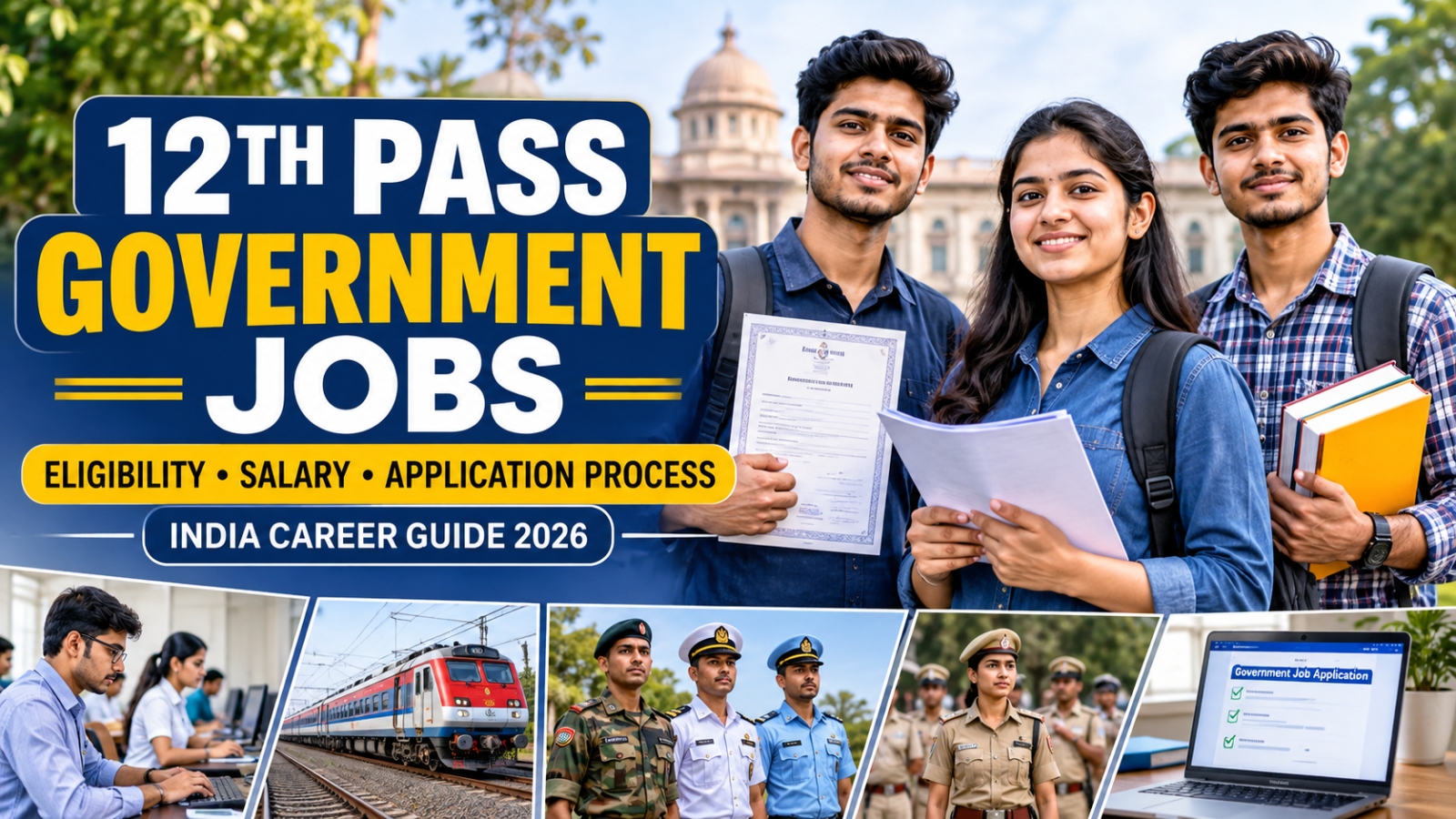
Completing Class 12 is an important milestone, but it does not mean students must immediately pursue a college degree before starting their careers. In India, several central government departments, railway organisations, defence forces, police departments and public-sector institutions offer employment opportunities to candidates who have passed their 12th examination.
For students who want financial independence, job security and a stable career, 12th pass government jobs in India can be an excellent starting point. These jobs offer different career paths, including clerical positions, railway services, defence recruitment, police constable positions, stenographer roles and administrative work.
One of the biggest advantages is that candidates from different educational streams, including Science, Commerce and Arts, can apply for many government recruitment examinations. However, certain positions have additional requirements, such as specific subjects in Class 12, typing speed, stenography skills, physical fitness or medical standards.
Popular recruitment opportunities include the SSC Combined Higher Secondary Level (SSC CHSL) examination, Railway Recruitment Board (RRB NTPC) undergraduate recruitment, UPSC National Defence Academy (NDA) examination, Indian Armed Forces recruitment and various state police recruitment examinations.
Understanding the eligibility criteria, salary structure, selection process and application procedure is essential before applying. This guide explains the major government job opportunities available after Class 12 and how to prepare for them.
1. Best Government Jobs After 12th in India
There are several government recruitment examinations that provide opportunities to 12th-pass candidates. Some recruit candidates for central government offices, while others offer employment in Indian Railways, defence services, paramilitary forces and state government departments.
The right examination depends on your educational background, age, interests, physical fitness and long-term career goals.
Let’s explore the most popular options.
1.1 SSC Combined Higher Secondary Level (SSC CHSL)
The Staff Selection Commission Combined Higher Secondary Level (SSC CHSL) examination is among the most popular government examinations for candidates who have completed Class 12.
SSC conducts this examination to recruit candidates for various Group C positions in central government ministries, departments and other government organisations.
It is particularly suitable for candidates interested in office administration, computer-based work, clerical responsibilities and data management.
Major posts available through SSC CHSL include:
-
Lower Divisional Clerk (LDC): Responsible for maintaining official records, handling correspondence, preparing documents and performing routine administrative activities.
-
Junior Secretariat Assistant (JSA): Performs clerical and secretarial duties, maintains files, processes official documents and assists government officers.
-
Data Entry Operator (DEO): Handles computer-based data entry, maintains digital records and processes information.
-
Postal Assistant (PA): Works in postal department offices, handling customer services, postal records and administrative responsibilities.
-
Sorting Assistant (SA): Assists in sorting and processing postal articles and managing mail operations.
Post availability and allocation depend on the vacancies notified for a particular recruitment cycle. Postal Assistant and Sorting Assistant positions should not be assumed to be available in every SSC CHSL notification.
Eligibility criteria
Candidates must generally have passed Class 12 or an equivalent examination from a recognised board or university.
For certain Data Entry Operator positions, a Science stream qualification with Mathematics is compulsory. Candidates applying for other eligible LDC, JSA and DEO positions generally do not need to belong to a particular educational stream.
The usual age requirement is 18–27 years, subject to the age calculation date specified in the notification and applicable category-based relaxation.
Salary structure
SSC CHSL offers attractive salaries under the 7th Central Pay Commission.
|
Post |
Pay level |
Basic pay |
|---|---|---|
|
LDC/JSA |
Level 2 |
₹19,900 |
|
DEO |
Level 4 |
₹25,500 |
|
DEO |
Level 5 |
₹29,200 |
In addition to basic pay, employees may receive Dearness Allowance (DA), House Rent Allowance (HRA), Transport Allowance and other admissible benefits.
The actual monthly salary depends on the posting location, applicable allowances and deductions.
Selection process
The SSC CHSL selection process generally involves:
-
Tier-I Computer-Based Examination.
-
Tier-II examination.
-
Skill Test or Typing Test, wherever applicable.
-
Document verification and other prescribed formalities.
Candidates applying for LDC and JSA positions should develop good typing skills. DEO aspirants should focus on data entry accuracy and speed.
Why choose SSC CHSL?
SSC CHSL is a suitable option for candidates who want a central government office job without completing graduation. It offers a structured career path, stable employment and opportunities for departmental promotions.
1.2 UPSC National Defence Academy and Naval Academy (NDA & NA) Examination
For students who dream of joining the Indian Armed Forces and serving the country, the UPSC National Defence Academy (NDA) and Naval Academy (NA) Examination is an important opportunity after Class 12.
The Union Public Service Commission (UPSC) conducts the NDA examination twice a year, subject to its examination calendar.
Successful candidates receive training through the National Defence Academy or the relevant Naval Academy entry route before proceeding towards their commissioned officer careers.
The examination offers opportunities in three major defence services:
-
Indian Army
-
Indian Navy
-
Indian Air Force
Educational eligibility
The educational requirements differ according to the service selected.
|
Defence wing |
Educational qualification |
|---|---|
|
Army Wing |
Class 12 pass in any stream |
|
Air Force Wing |
Class 12 with Physics, Chemistry and Mathematics |
|
Naval Wing |
Class 12 with Physics, Chemistry and Mathematics |
|
Naval Academy 10+2 Cadet Entry |
Class 12 with Physics, Chemistry and Mathematics |
Students appearing in their Class 12 examinations may also be eligible, subject to the conditions specified in the notification.
Age limit and other requirements
The NDA examination has a strict age and date-of-birth eligibility requirement. Candidates generally fall within the prescribed age range of approximately 16.5–19.5 years, but the exact eligible birth-date window must always be checked in the relevant UPSC notification.
Candidates must also satisfy the prescribed nationality, marital status, physical fitness and medical standards.
Selection process
The NDA selection process is different from ordinary clerical recruitment examinations.
It generally includes:
-
Written examination conducted by UPSC.
-
Services Selection Board (SSB) interview.
-
Psychological assessment.
-
Group testing activities.
-
Personal interview.
-
Medical examination.
-
Final merit list and academy allocation.
The written examination includes Mathematics and the General Ability Test (GAT). The GAT assesses English, general knowledge, science and other relevant subjects.
Salary and career opportunities
NDA candidates undergo training before receiving commissioned officer appointments. During the training period, eligible cadets receive a prescribed stipend.
After successful commissioning, officers are appointed under the applicable defence pay structure.
The starting basic pay for a Lieutenant in the Army and equivalent entry-level commissioned officer ranks in the Navy and Air Force is generally ₹56,100 per month under Level 10 of the defence pay matrix, with applicable allowances and benefits.
Candidates should understand that NDA is not simply an entry-level government job. It is a long-term defence career involving leadership, discipline, responsibility and service to the nation.
Official examination information is available through the UPSC official website.
1.3 Railway Recruitment Board (RRB NTPC) Undergraduate Jobs
Indian Railways is one of the largest government employment providers in the country. It regularly conducts recruitment examinations for various technical and non-technical positions.
The Railway Recruitment Board (RRB) Non-Technical Popular Categories (NTPC) Undergraduate Examination is particularly relevant to candidates who have completed Class 12.
It provides opportunities to work in railway stations, ticket counters, administrative offices and railway operations.
Popular RRB NTPC undergraduate posts
Commercial Cum Ticket Clerk
Commercial Cum Ticket Clerks handle passenger ticketing activities, assist railway passengers and perform commercial responsibilities at railway stations.
This position is suitable for candidates interested in customer service and railway administration.
Accounts Clerk Cum Typist
Accounts Clerks assist with financial records, accounting documents, bills and other administrative work.
Candidates should have good computer knowledge and typing skills.
Junior Clerk Cum Typist
Junior Clerks perform general office responsibilities, maintain records, prepare documents and assist senior railway employees.
Trains Clerk
Trains Clerks assist in maintaining train-related records, preparing operational documents and supporting railway traffic management activities.
Educational qualification
Candidates generally need to pass Class 12 or an equivalent examination from a recognised board.
Some RRB NTPC undergraduate notifications prescribe at least 50% aggregate marks. The condition may not apply to SC/ST candidates, Persons with Benchmark Disabilities, ex-servicemen and candidates holding qualifications higher than Class 12, as specified in the notification.
Typing proficiency is also relevant for posts such as Accounts Clerk Cum Typist and Junior Clerk Cum Typist.
Age limit
The age requirement is recruitment-specific. Candidates should check the normal age range, applicable one-time relaxations, category relaxations and the date used for calculating age.
Salary structure
RRB NTPC undergraduate positions offer salaries under the 7th Central Pay Commission.
|
Post |
Pay level |
Initial basic pay |
|---|---|---|
|
Commercial Cum Ticket Clerk |
Level 3 |
₹21,700 |
|
Accounts Clerk Cum Typist |
Level 2 |
₹19,900 |
|
Junior Clerk Cum Typist |
Level 2 |
₹19,900 |
|
Trains Clerk |
Level 2 |
₹19,900 |
Employees may receive additional allowances, including DA, HRA and Transport Allowance, depending on applicable rules and posting.
Selection process
The RRB NTPC selection process generally includes:
-
First Stage Computer-Based Test (CBT 1).
-
Second Stage Computer-Based Test (CBT 2).
-
Typing Skill Test, where applicable.
-
Document verification.
-
Medical examination.
The exact examination stages and requirements depend on the post and recruitment notification.
Current recruitment example
RRB NTPC Undergraduate Recruitment 2026 under CEN 07/2026 has advertised 1,688 provisional vacancies across four undergraduate post categories. The reported application deadline was 13 November 2026, which has passed as of 14 November 2026. Candidates should check the official railway recruitment portal for subsequent updates rather than assuming that applications remain open.
Visit the Railway Recruitment Board website or the relevant regional RRB website for recruitment notices.
1.4 Indian Army, Navy and Air Force Recruitment
Candidates interested in uniformed services can also explore recruitment opportunities in the Indian Army, Indian Navy and Indian Air Force.
These organisations provide different entry routes for candidates with Class 12 qualifications. However, educational requirements vary depending on the trade, technical position and recruitment scheme.
One important opportunity is the Agnipath Scheme, through which eligible candidates are recruited as Agniveers for a four-year engagement period.
Indian Army Agniveer recruitment
The Indian Army conducts recruitment for different Agniveer categories.
Some relevant opportunities include:
-
Agniveer Technical.
-
Agniveer Clerk/Store Keeper Technical.
-
Agniveer General Duty.
-
Other notified categories, depending on educational eligibility.
Agniveer Clerk/Store Keeper Technical is particularly relevant for 12th-pass candidates from Arts, Commerce and Science backgrounds, subject to the prescribed marks and subject requirements.
For example, the cited recruitment eligibility criteria specify 60% aggregate marks and at least 50% in each subject for the Clerk/Store Keeper Technical category, along with specific English and Mathematics/Accounts/Book Keeping requirements.
Agniveer Technical positions generally require relevant Science subjects or accepted equivalent technical qualifications.
Candidates must also satisfy prescribed physical and medical standards.
Indian Navy Agniveer recruitment
The Indian Navy offers opportunities through different Agniveer entries.
A particularly relevant option is Agniveer SSR (Senior Secondary Recruit).
Candidates generally need:
-
Class 12 qualification with Mathematics and Physics.
-
At least 50% aggregate marks, subject to the applicable notification.
-
The prescribed age and medical requirements.
Certain accepted engineering diploma and vocational qualifications may also satisfy the educational requirements.
Agniveer MR is another Navy recruitment category, but it generally requires Class 10 rather than Class 12.
Indian Air Force recruitment
The Indian Air Force also offers opportunities through the Agnipath recruitment framework, including Agniveervayu.
For eligible Science candidates, the prescribed educational requirements generally involve Mathematics, Physics and English, with the required aggregate and English marks.
Other educational routes may be available under the applicable recruitment notification.
Candidates should carefully distinguish between Science and non-Science eligibility because the subject requirements are not identical.
Agniveer salary structure
Agniveers receive a customised monthly package that increases each year.
|
Year of service |
Monthly package |
Approximate monthly in-hand amount |
|---|---|---|
|
First year |
₹30,000 |
₹21,000 |
|
Second year |
₹33,000 |
₹23,100 |
|
Third year |
₹36,500 |
₹25,550 |
|
Fourth year |
₹40,000 |
₹28,000 |
A portion of the monthly package is contributed to the Agniveer Corpus Fund, with a matching contribution from the government.
On completion of the four-year engagement, eligible Agniveers receive the Seva Nidhi package, subject to the scheme’s applicable terms.
Agniveers do not automatically receive regular pensionary benefits or gratuity under this arrangement. Up to 25% of each batch may be selected for regular cadre enrolment in the services, subject to organisational requirements and selection criteria.
Important consideration
Agniveer recruitment should be evaluated differently from permanent central government employment. Candidates should understand the four-year engagement structure, exit benefits and subsequent career opportunities before applying.
Official recruitment information is available through:
1.5 Central Armed Police Forces (CAPF) Recruitment
The Central Armed Police Forces provide another career opportunity for young candidates interested in national security, internal security and law enforcement.
The major forces include:
-
Border Security Force (BSF): Responsible for guarding India’s international borders and preventing cross-border illegal activities.
-
Central Reserve Police Force (CRPF): Performs internal security, counter-insurgency and law-and-order duties.
-
Central Industrial Security Force (CISF): Provides security to airports, industrial establishments and other important installations.
-
Indo-Tibetan Border Police (ITBP): Guards the India-China border and operates in challenging high-altitude environments.
-
Sashastra Seema Bal (SSB): Performs border-guarding responsibilities along India’s borders with Nepal and Bhutan.
The Staff Selection Commission conducts the Constable (General Duty) recruitment examination for several of these forces.
Eligibility criteria
An important distinction is that SSC GD Constable recruitment generally requires a Class 10 qualification rather than Class 12.
Therefore, 12th-pass candidates can also apply if they satisfy the prescribed age, nationality, physical and other eligibility conditions.
The recruitment notice specifies the age limit, educational qualification, physical measurements and other requirements.
Selection process
The selection process generally involves:
-
Computer-Based Examination.
-
Physical Standard Test (PST).
-
Physical Efficiency Test (PET).
-
Medical examination.
-
Document verification.
The exact standards vary according to the recruitment notification and applicable candidate categories.
Salary structure
Constable (GD) positions in the relevant central forces generally fall under Pay Level 3, with a basic pay range of ₹21,700–₹69,100.
Additional admissible allowances may include DA, HRA, risk or hardship-related allowances, depending on the force and posting.
The SSC GD recruitment process is a useful option for candidates who are physically fit and interested in uniformed government service.
1.6 Police Constable Recruitment – Delhi Police, UP Police and State Police
State police departments and Union Territory police organisations regularly announce recruitment for Constable positions.
These jobs are suitable for candidates interested in maintaining law and order, public safety and community security.
Some popular recruitment opportunities include:
-
Delhi Police Constable.
-
Uttar Pradesh Police Constable.
-
Rajasthan Police Constable.
-
Haryana Police Constable.
-
Bihar Police Constable.
-
Madhya Pradesh Police Constable.
-
Other state police recruitment examinations.
Educational qualification
Many police constable recruitment notifications require candidates to have passed Class 12 from a recognised board.
However, educational requirements differ between states and individual posts.
Some specialised positions may require additional qualifications, such as a valid driving licence or technical knowledge.
Age limit
The age limit depends on the recruiting state, post, gender and category.
Reserved-category candidates may receive age relaxation according to the applicable recruitment rules.
Physical standards
Police recruitment places significant importance on physical fitness.
Candidates may need to meet prescribed standards for:
-
Height.
-
Chest measurement, where applicable.
-
Weight or other medical standards.
-
Running.
-
Long jump.
-
High jump.
-
Other physical efficiency activities.
Salary structure
Police constable salaries vary according to the state government and applicable pay matrix.
For example, Delhi Police Constable (Executive) recruitment has a Level 3 pay scale of ₹21,700–₹69,100 under the applicable recruitment rules.
State police salaries may be different, so candidates should refer to the specific notification rather than relying on a single national salary figure.
1.7 SSC Stenographer Grade C and Grade D Examination
Candidates who have good English or Hindi language skills and are interested in office administration can consider the SSC Stenographer Grade C and Grade D Examination.
The Staff Selection Commission conducts this examination to recruit stenographers for various government ministries, departments and organisations.
A stenographer is responsible for recording spoken information, preparing transcripts, handling official correspondence and supporting administrative work.
Educational qualification
Candidates must generally have passed Class 12 or an equivalent examination from a recognised board.
There is no universal requirement to belong to a specific stream.
However, candidates need to develop shorthand and transcription skills to perform the job successfully.
Age limit
The age requirements specified in the 2026 SSC notification are:
|
Post |
Age limit |
|---|---|
|
Stenographer Grade C |
18–30 years |
|
Stenographer Grade D |
18–27 years |
Category-based age relaxation is available according to government rules.
Selection process
The recruitment process generally includes:
-
Computer-Based Examination.
-
Stenography Skill Test.
-
Document verification.
The Computer-Based Examination assesses General Intelligence and Reasoning, General Awareness and English Language and Comprehension.
Candidates who qualify must demonstrate their shorthand and transcription abilities during the skill test.
Salary structure
Stenographer Grade C and Grade D positions fall under different pay levels, depending on the allotted department and post.
Grade C generally offers a higher pay level than Grade D. The exact salary, allowances and departmental benefits depend on the recruitment rules and posting.
Who should apply?
This examination is particularly useful for students who enjoy language-based work, typing, documentation and administrative responsibilities.
Developing shorthand proficiency before the examination can provide a significant advantage.
1.8 SSC General Duty (GD) Constable and Multi-Tasking Staff (MTS) Recruitment
Apart from SSC CHSL, the Staff Selection Commission conducts several other recruitment examinations that 12th-pass candidates can consider.
Two important examples are SSC GD Constable and SSC Multi-Tasking Staff (MTS).
Although these examinations generally have a lower minimum educational qualification, they remain relevant to candidates who have completed Class 12.
SSC GD Constable
SSC GD recruitment provides opportunities in BSF, CRPF, CISF, ITBP, SSB, Assam Rifles and other notified organisations.
Candidates generally need to have passed Class 10.
The recruitment process includes a Computer-Based Examination, physical tests, medical examination and document verification.
It is suitable for candidates interested in security and uniformed services.
SSC Multi-Tasking Staff (MTS)
SSC MTS recruitment provides opportunities for various non-technical support positions in central government departments.
Typical responsibilities may include:
-
Maintaining office records.
-
Handling files and documents.
-
Assisting with routine office activities.
-
Maintaining office cleanliness and organisation.
-
Supporting departmental staff.
-
Performing other duties assigned by the department.
Candidates generally need to have passed Class 10 from a recognised board.
The examination may also include a Havaldar recruitment component for CBIC and CBN, which has additional physical requirements.
Salary structure
SSC MTS and SSC GD Constable positions generally fall under Pay Level 1 and Pay Level 3 respectively.
|
Recruitment |
Typical basic pay |
|---|---|
|
SSC MTS |
₹18,000 |
|
SSC GD Constable |
₹21,700 |
These are starting basic pay figures, not guaranteed take-home salaries. Allowances, deductions and posting conditions affect the final monthly amount.
Important point: A candidate who has passed Class 12 is eligible to apply for these examinations if they satisfy the other requirements. However, passing Class 12 does not automatically change the pay level or job designation.
2. Eligibility Criteria for 12th Pass Government Jobs in India
Before applying for any government recruitment examination, candidates should understand the eligibility requirements. Although Class 12 is the minimum educational qualification for many positions, other conditions can determine whether an applicant is eligible.
The major eligibility factors include educational qualification, age limit, educational stream, nationality, physical standards and additional skills.
2.1 Educational Qualification
The most important requirement is passing the Class 12 examination from a recognised education board.
Candidates who have completed their education through recognised boards such as CBSE, ICSE or state education boards can generally apply, subject to the recruitment-specific conditions.
However, not every government examination has the same educational requirements.
|
Government examination |
Minimum educational qualification |
|---|---|
|
SSC CHSL |
Class 12 pass |
|
UPSC NDA Army Wing |
Class 12 pass |
|
UPSC NDA Air Force and Navy Wings |
Class 12 with PCM |
|
RRB NTPC Undergraduate |
Class 12 pass, with prescribed marks where applicable |
|
SSC Stenographer |
Class 12 pass |
|
Delhi Police Constable |
Class 12 pass |
|
Indian Army Agniveer Clerk |
Class 12 with prescribed marks and subjects |
|
Indian Navy Agniveer SSR |
Class 12 with Mathematics and Physics |
|
SSC GD Constable |
Class 10 pass |
|
SSC MTS |
Class 10 pass |
Candidates should carefully check the educational qualification mentioned in the official recruitment notification.
For example, a student from the Commerce stream may be eligible for SSC CHSL LDC and JSA positions but may not satisfy the subject requirements for certain Air Force, Navy or technical defence positions.
2.2 Age Limit and Age Relaxation
Age is another important eligibility condition for government recruitment.
Different examinations have different minimum and maximum age requirements. Some examinations also calculate age using a specific date mentioned in the notification.
The following table provides an indicative overview.
|
Examination |
Typical age requirement |
|---|---|
|
SSC CHSL |
18–27 years |
|
SSC Stenographer Grade C |
18–30 years |
|
SSC Stenographer Grade D |
18–27 years |
|
UPSC NDA |
Approximately 16.5–19.5 years |
|
RRB NTPC Undergraduate |
Depends on the notification |
|
Delhi Police Constable |
Generally 18–25 years |
|
Agniveer recruitment |
Generally around 17.5–21/22 years, depending on the entry |
These are general reference ranges, not a substitute for the exact date-of-birth conditions in a recruitment advertisement.
Age relaxation for reserved categories
The Government of India provides age relaxation to eligible reserved-category candidates under applicable recruitment rules.
Common examples include:
-
SC candidates: Generally 5 years of relaxation.
-
ST candidates: Generally 5 years of relaxation.
-
OBC candidates: Generally 3 years of relaxation.
-
PwBD candidates: Relaxation according to the applicable recruitment rules.
-
Ex-servicemen: Relaxation according to the relevant government provisions.
Additional relaxations may apply to specific recruitment categories.
Candidates must possess valid supporting documents to claim applicable age relaxation.
2.3 Educational Stream Requirements
One common question among students is whether Arts, Commerce or Science students can apply for government jobs after Class 12.
The answer is yes. Many government examinations accept candidates from all three streams.
However, certain technical and defence positions require specific subjects.
Arts students
Arts students can consider SSC CHSL, SSC Stenographer, many police constable positions, eligible RRB NTPC undergraduate posts and the Army Wing of NDA.
Commerce students
Commerce students can apply for SSC CHSL, RRB NTPC undergraduate positions, SSC Stenographer and various clerical recruitment examinations.
They may also be eligible for specific Army Agniveer Clerk/Store Keeper Technical opportunities if they meet the prescribed subject and marks requirements.
Science students
Science students can apply for most general 12th-pass recruitment examinations.
They may also have additional opportunities in technical defence positions, the Navy, Air Force and certain technical recruitment categories.
The important point is to match your Class 12 subjects with the requirements of the examination.
2.4 Physical and Medical Standards
Physical fitness is particularly important for defence, police and paramilitary recruitment.
Candidates applying for office-based positions such as SSC CHSL and SSC Stenographer generally do not have the same physical requirements as candidates applying for police or defence positions.
However, uniformed services may prescribe specific physical and medical standards.
These can include:
-
Minimum height requirements.
-
Chest measurements for applicable categories.
-
Weight and body composition standards.
-
Vision requirements.
-
Hearing standards.
-
Running and endurance tests.
-
General medical fitness.
-
Other service-specific physical conditions.
For example, a candidate applying for Delhi Police Constable or CAPF recruitment may need to qualify in physical tests after clearing the written examination.
NDA candidates must satisfy detailed medical and physical fitness standards established by the respective defence services.
Practical advice: Start improving your physical fitness well before applying for defence or police recruitment. Regular running, exercise, flexibility training and a balanced routine can help you prepare for physical efficiency tests.
3. Salary Structure and Benefits of Government Jobs After 12th
Salary is one of the major reasons students prefer government employment.
However, the salary of a 12th-pass government employee depends on the department, job designation, pay level, location and applicable allowances.
Central government civilian positions generally follow the 7th Central Pay Commission pay matrix, while defence and other recruitment categories may have separate salary arrangements.
3.1 Salary Comparison of Popular Government Jobs
The following table provides an indicative comparison of popular opportunities.
|
Government job |
Starting basic pay / package |
|---|---|
|
SSC CHSL LDC/JSA |
₹19,900 |
|
SSC CHSL DEO |
₹25,500 onwards |
|
RRB NTPC Commercial Cum Ticket Clerk |
₹21,700 |
|
RRB NTPC Accounts Clerk |
₹19,900 |
|
RRB NTPC Junior Clerk |
₹19,900 |
|
RRB NTPC Trains Clerk |
₹19,900 |
|
Delhi Police Constable |
₹21,700 |
|
CAPF Constable GD |
₹21,700 |
|
SSC MTS |
₹18,000 |
|
SSC Stenographer |
Depends on grade and allotted pay level |
|
NDA commissioned officer |
₹56,100 starting basic pay after commissioning |
|
Agniveer |
₹30,000 monthly package in the first year |
Note: These figures represent basic pay or the specified Agniveer package, not uniform monthly take-home salaries. Actual earnings depend on applicable allowances, deductions, service conditions and recruitment rules.
3.2 Additional Allowances and Benefits
Government employees may receive several financial and non-financial benefits.
The applicable benefits depend on the department, service rules and employment category.
Dearness Allowance (DA)
Dearness Allowance is provided to eligible government employees to compensate for changes in the cost of living.
The government revises DA periodically according to applicable rules.
House Rent Allowance (HRA)
Employees who qualify under the applicable rules may receive HRA depending on their posting location and accommodation arrangements.
The rate generally differs between city categories.
Transport Allowance
Eligible employees may receive Transport Allowance to help cover commuting expenses.
The amount depends on the applicable pay level and location.
Medical facilities
Eligible government employees may receive medical facilities under the relevant departmental or government healthcare schemes.
Leave benefits
Government employment generally provides structured leave entitlements, including casual leave, earned leave and other applicable leave categories.
Retirement benefits
Permanent government employees may receive retirement benefits under the pension or retirement framework applicable to their appointment.
Candidates must distinguish between regular government appointments and contractual or fixed-term engagements.
For example, Agniveer recruitment has a four-year engagement structure and a specific Seva Nidhi exit benefit. It should not be treated as identical to a regular permanent government appointment.
3.3 Career Growth and Promotion Opportunities
A government job after Class 12 can provide opportunities for professional development.
Employees working in clerical positions may progress to higher administrative responsibilities through departmental promotions, qualifying examinations and service experience.
Similarly, railway employees may progress to higher positions according to departmental promotion policies and eligibility conditions.
Police and paramilitary personnel may also have promotion opportunities through internal examinations, seniority and prescribed service requirements.
In defence services, career progression depends on the applicable service structure, selection criteria and performance.
Candidates should not evaluate a government job only on its initial salary. It is equally important to understand the promotion structure, working environment, transfer policy and long-term career opportunities.
4. Government Job Selection Process and How to Apply Online
The selection process for 12th-pass government jobs varies according to the recruiting organisation and job category.
Some positions require only a written examination and document verification, while others involve computer-based examinations, typing tests, physical efficiency tests and medical assessments.
Understanding the recruitment process helps candidates prepare systematically and avoid application mistakes.
4.1 Written Examination and Computer-Based Test (CBT)
Most popular government recruitment examinations involve a written examination or Computer-Based Test (CBT).
Candidates are tested on subjects such as:
-
General Intelligence and Reasoning.
-
General Awareness.
-
Quantitative Aptitude.
-
Mathematics.
-
English Language.
-
General Science.
-
Current Affairs.
For example, SSC CHSL generally includes sections covering English Language, General Intelligence, Quantitative Aptitude and General Awareness.
RRB NTPC examinations also assess Mathematics, General Intelligence and Reasoning, and General Awareness.
UPSC NDA has a different examination pattern, with Mathematics and the General Ability Test.
Candidates should download the syllabus and examination pattern before starting preparation.
4.2 Physical Efficiency Test (PET) and Physical Standard Test (PST)
Candidates applying for police, CAPF and certain defence recruitment opportunities may need to qualify in physical tests.
A Physical Efficiency Test (PET) evaluates physical endurance and performance.
Activities may include running, long jump, high jump and other prescribed exercises.
A Physical Standard Test (PST) checks whether candidates satisfy the required physical measurements.
For example, police and CAPF recruitment may specify different height and chest standards depending on gender, category, region and recruitment rules.
Candidates should practise according to the official standards rather than following unofficial fitness targets.
4.3 Skill Test and Typing Test
Certain government jobs require specialised skills in addition to written examination performance.
SSC CHSL and RRB NTPC undergraduate recruitment may include typing tests for applicable clerical posts.
SSC Stenographer recruitment requires candidates to demonstrate shorthand and transcription skills.
For computer-based clerical positions, candidates should develop:
-
Basic computer knowledge.
-
Keyboard typing accuracy.
-
English or Hindi typing proficiency, where applicable.
-
Word processing skills.
-
Data entry accuracy.
-
Familiarity with spreadsheets and digital documents.
Candidates should remember that qualifying the written examination does not automatically guarantee selection. They must also pass the prescribed skill tests whenever applicable.
4.4 Document Verification and Medical Examination
Document verification is an important stage of government recruitment.
Candidates who qualify in the preceding stages may be asked to provide original documents for verification.
Commonly required documents include:
-
Class 10 marksheet and certificate.
-
Class 12 marksheet and certificate.
-
Government-approved identity proof.
-
Recent passport-size photographs.
-
Signature.
-
Category certificate, where applicable.
-
EWS certificate, where applicable.
-
PwBD certificate, where applicable.
-
Domicile or residence certificate, where required.
-
Other documents mentioned in the recruitment notification.
Candidates applying for defence, police and paramilitary services may also undergo medical examinations.
The medical examination checks whether the candidate satisfies the physical and medical standards required for the particular service.
Any discrepancy in educational certificates, date of birth, category details or other application information can create problems during verification.
Therefore, applicants should keep all documents ready before applying.
4.5 Step-by-Step Process to Apply for Government Jobs After 12th
Most central government recruitment applications are submitted online through the official recruitment portals.
Although the application interface differs between organisations, the general procedure remains similar.
Step 1: Identify suitable government vacancies
First, identify recruitment examinations that match your educational qualification, age and career interests.
For example:
-
Interested in clerical work? Consider SSC CHSL.
-
Interested in railway employment? Explore RRB NTPC undergraduate recruitment.
-
Interested in defence services? Check NDA and Agniveer opportunities.
-
Interested in police services? Explore state police and Delhi Police recruitment.
-
Interested in administrative language work? Consider SSC Stenographer.
Step 2: Read the official notification
Download and read the detailed recruitment notification.
Pay particular attention to:
-
Educational qualification.
-
Age limit.
-
Age relaxation.
-
Number of vacancies.
-
Application dates.
-
Examination pattern.
-
Selection procedure.
-
Application fee.
-
Required documents.
Never rely entirely on social media posts or unofficial job websites.
Step 3: Complete online registration
Visit the official recruitment portal and complete the registration process.
Depending on the organisation, candidates may need to provide personal information, mobile number, email address and identity-related details.
Use an active mobile number and email address because recruitment updates may be communicated through them.
Step 4: Fill out the application form
Enter the required details carefully.
These may include:
-
Candidate’s full name.
-
Date of birth.
-
Father’s and mother’s names.
-
Educational qualification.
-
Category.
-
Address.
-
Examination centre preference.
-
Other information requested in the application.
Ensure that the information matches your official documents.
Step 5: Upload documents and photographs
Upload the photograph, signature and other documents according to the portal’s prescribed file size and format.
An incorrect photograph or signature can lead to application-related problems.
Step 6: Pay the application fee
Pay the examination fee through the available payment methods, if applicable.
Some categories, including eligible women, SC, ST and PwBD candidates, may receive fee exemptions depending on the examination rules.
Always check the relevant notification.
Step 7: Submit the application form
Review the complete application before final submission.
Check your name, date of birth, educational details, category and examination preferences.
After submission, download or print the application confirmation for future reference.
Step 8: Download the admit card
Once the examination authority releases the admit card, download it from the official portal.
Check the examination date, reporting time, centre address and instructions.
Step 9: Appear for the examination
Reach the examination centre on time with the required admit card and identity documents.
Follow all examination instructions.
Step 10: Check the result and subsequent selection stages
After the examination, regularly check the official website for answer keys, results, cut-off marks, skill test schedules, physical test information and document verification notices.
4.6 Important Official Websites for Government Job Applications
Candidates should use authentic government recruitment portals to find vacancies and submit applications.
|
Organisation |
Official website |
|---|---|
|
Staff Selection Commission |
|
|
Union Public Service Commission |
|
|
Railway Recruitment Boards |
|
|
Indian Army |
|
|
Indian Navy |
|
|
Indian Air Force |
|
|
Delhi Police |
|
|
Uttar Pradesh Police Recruitment |
Candidates should check the official website of the relevant recruiting organisation regularly because application dates, vacancies and examination schedules can change.
5. Preparation Tips to Crack Government Exams After 12th
Getting a government job after Class 12 requires consistent preparation, a clear understanding of the examination pattern and regular practice.
Many students start preparing without understanding the syllabus or choosing a specific examination. This often results in wasted time and confusion.
A better approach is to select suitable examinations and develop a structured preparation strategy.
5.1 Choose the Right Government Examination
Start by identifying your strengths and career preferences.
If you prefer office-based employment, SSC CHSL, SSC Stenographer and RRB NTPC undergraduate recruitment may be suitable.
If you are interested in defence services, consider NDA and relevant Agniveer entries.
If you enjoy physical activities and want a uniformed career, explore police constable and CAPF recruitment.
Choosing an examination based on your interests and eligibility helps you focus your preparation.
5.2 Understand the Complete Syllabus
Download the latest syllabus and examination pattern from the official recruitment website.
Identify the subjects carrying significant weightage and prepare accordingly.
For examinations such as SSC CHSL and RRB NTPC, candidates should focus on:
-
Mathematics.
-
Reasoning.
-
General Awareness.
-
English Language.
-
Current Affairs.
NDA candidates need additional preparation in Mathematics and the General Ability Test.
SSC Stenographer candidates should also devote time to shorthand and transcription practice.
5.3 Practise Previous Years’ Question Papers
Previous years’ question papers help candidates understand the examination structure and common question patterns.
Practise questions under timed conditions.
After completing each mock test, analyse your mistakes and identify weak areas.
Instead of solving hundreds of questions without reviewing them, focus on understanding why an answer is correct or incorrect.
5.4 Improve Time Management
Government examinations are competitive, and candidates must solve questions within a limited time.
Create a daily timetable that gives sufficient attention to every subject.
For example, a student preparing for SSC CHSL may divide study time between mathematics, reasoning, English and general awareness.
Include revision and mock tests in the weekly schedule.
5.5 Stay Updated with Current Affairs
General Awareness is an important part of several government recruitment examinations.
Read reliable news sources and revise important developments relating to:
-
Indian politics and governance.
-
National and international events.
-
Government schemes.
-
Indian history.
-
Geography.
-
Indian economy.
-
Science and technology.
-
Sports.
-
Awards and honours.
Maintain short revision notes to make preparation easier.
5.6 Prepare for Physical Tests Early
Candidates preparing for police, defence and CAPF recruitment should not wait until the written examination results are announced before starting physical training.
Develop a regular exercise routine that includes running, strength training, stretching and endurance exercises.
Maintain a healthy diet and adequate sleep.
Follow the specific physical requirements mentioned in the recruitment notification.
5.7 Avoid Common Application and Preparation Mistakes
Many candidates lose opportunities because of avoidable errors.
Keep these points in mind:
-
Do not apply without checking the age calculation date.
-
Do not assume every 12th-pass examination accepts all educational streams.
-
Do not rely on unofficial vacancy announcements.
-
Do not wait until the final day to submit the application.
-
Do not upload incorrect photographs or documents.
-
Do not ignore typing or skill test requirements.
-
Do not assume that every government job provides permanent employment.
-
Do not pay money to unauthorised agents promising government recruitment.
Government recruitment should always be based on the official selection process and published merit criteria.

FAQ: 12th Pass Government Jobs in India
1. Which is the best government job after 12th in India?
SSC CHSL, RRB NTPC undergraduate recruitment, UPSC NDA, SSC Stenographer, Delhi Police Constable and eligible defence recruitment opportunities are among the popular choices.
The best option depends on your educational stream, age, interests and career goals.
2. Can I get a government job immediately after passing Class 12?
Yes. Several government departments recruit candidates with Class 12 qualifications for clerical, administrative, railway, police and defence positions.
You must satisfy the applicable eligibility criteria and clear the selection process.
3. Which government job offers the highest salary after 12th?
Salary depends on the position and career pathway.
SSC CHSL DEO positions can offer higher starting basic pay than many entry-level clerical positions. NDA provides a pathway towards commissioned officer employment, with a starting basic pay of ₹56,100 after commissioning.
However, NDA requires additional selection and training and is not an ordinary direct clerical appointment.
4. Can Arts students apply for government jobs after 12th?
Yes. Arts students can apply for many examinations, including SSC CHSL, SSC Stenographer, RRB NTPC undergraduate recruitment, the NDA Army Wing and eligible police recruitment.
Some technical and defence positions require specific Science subjects.
5. Can Commerce students apply for SSC CHSL?
Yes. Commerce students who have passed Class 12 from a recognised board can generally apply for eligible SSC CHSL positions.
Certain DEO positions have additional subject requirements, so the notification should be checked.
6. Can Science students apply for railway jobs after 12th?
Yes. Science students can apply for eligible RRB NTPC undergraduate positions if they satisfy the educational, age and other prescribed requirements.
7. What is the age limit for government jobs after 12th?
There is no single age limit for all government jobs.
SSC CHSL generally has an age limit of 18–27 years, while SSC Stenographer and defence recruitment have different requirements.
Candidates should check the latest recruitment notification.
8. Can female candidates apply for government jobs after 12th?
Yes. Female candidates can apply for several government recruitment examinations, including SSC CHSL, SSC Stenographer, eligible railway posts, NDA and notified police and defence recruitment opportunities.
Some recruitment categories may have specific eligibility conditions.
9. Is SSC CHSL a permanent government job?
SSC CHSL recruits candidates for regular government posts, subject to the applicable service and appointment rules.
Candidates appointed to eligible regular posts receive the benefits and service conditions prescribed for their positions.
10. Is RRB NTPC available for 12th-pass candidates?
Yes. RRB NTPC has undergraduate-level recruitment for positions such as Commercial Cum Ticket Clerk, Accounts Clerk Cum Typist, Junior Clerk Cum Typist and Trains Clerk.
The qualification and age requirements are specified in each recruitment notification.
11. Can I apply for SSC GD after completing Class 12?
Yes. SSC GD generally requires Class 10 as the minimum educational qualification.
Therefore, candidates who have passed Class 12 can also apply if they satisfy the other eligibility requirements.
12. Is a typing test compulsory for every SSC CHSL post?
No. Typing or skill tests apply according to the post and recruitment rules.
LDC and JSA candidates generally need to qualify in the prescribed typing test, while DEO candidates have a data entry skill test.
13. Which government jobs after 12th do not require a physical test?
Office-based positions such as SSC CHSL clerical posts and SSC Stenographer generally do not require the same PET or PST stages as police and paramilitary recruitment.
However, candidates must satisfy all other applicable requirements.
14. Can I apply for government jobs while waiting for my Class 12 results?
Some recruitment notifications allow candidates appearing in Class 12 examinations to apply provisionally.
However, they must obtain the required qualification by the prescribed cut-off date.
Check the specific notification before applying.
15. What documents are required for government job applications?
Common documents include Class 10 and 12 certificates, identity proof, photographs, signatures and applicable category or domicile certificates.
The exact requirements differ between recruitment organisations.
16. How can I find the latest 12th-pass government vacancies?
Regularly check SSC, UPSC, RRB, Indian Army, Indian Navy, Indian Air Force and relevant state recruitment websites.
You can also follow reliable government employment news sources, but always verify vacancy information through the official notification.
17. Are government jobs after 12th available without an entrance examination?
Most popular central government recruitment positions require a competitive selection process.
Some departmental or special recruitment categories may follow different procedures, but candidates should never assume selection without an examination unless the official recruitment rules clearly provide for it.
18. Can I prepare for multiple government examinations simultaneously?
Yes. Candidates can prepare for multiple examinations when their syllabuses overlap.
For example, SSC CHSL and RRB NTPC share several subjects, including Mathematics, Reasoning and General Awareness.
However, candidates should separately prepare for examination-specific topics and skill tests.
19. What is the difference between a permanent government job and an Agniveer position?
A regular government appointment follows the applicable service rules and employment conditions.
Agniveer recruitment provides a four-year engagement under the Agnipath Scheme, with a specific salary package and Seva Nidhi benefit at the end of the engagement.
The two employment structures should not be treated as equivalent.
20. Is graduation necessary for all government jobs?
No. Many entry-level government positions accept Class 10 or Class 12 qualifications.
However, higher administrative and professional positions frequently require a graduation degree or specialised qualifications.
Conclusion
Getting a government job after Class 12 is a realistic career opportunity for students who want to start earning early and build a stable professional future.
From SSC CHSL and RRB NTPC undergraduate recruitment to UPSC NDA, Indian Armed Forces, CAPF and police constable recruitment, there are several opportunities available across different departments and employment categories.
The most important step is choosing an examination that matches your educational qualification, age, interests and career expectations.
Students interested in office-based employment can focus on SSC CHSL and SSC Stenographer. Those who prefer railway services can explore RRB NTPC undergraduate positions. Candidates passionate about national security and defence can consider NDA and eligible Agniveer recruitment opportunities.
Before applying, carefully read the official notification, verify the eligibility criteria, understand the salary structure and prepare for every stage of the selection process.
Do not wait until the last moment to prepare. Start building your subject knowledge, practising previous years’ question papers and improving your skills today.
Visit the official recruitment websites regularly to stay informed about new vacancies, application dates, admit cards, examination schedules and results. With consistent preparation, accurate information and the right career choice, you can take your first step towards a rewarding government career after Class 12.
EDITORIAL NOTE
This article uses 2026 recruitment information available as of 14 November 2026. Vacancy numbers, application windows, age limits, pay scales and selection stages can change between recruitment cycles. Always verify the latest official notification before applying. In particular, the SSC CHSL 2026 and RRB NTPC Undergraduate 2026 application deadlines discussed above have already passed.
FAQ: About 12th Pass Government Jobs in India
1. Which are the best government jobs after 12th in India?
Some popular options include SSC CHSL, RRB NTPC undergraduate posts, SSC Stenographer, UPSC NDA, Indian Army Agniveer, Delhi Police Constable and state police recruitment.
2. Can I get a government job after passing 12th without graduation?
Yes. Several central and state government departments recruit candidates who have completed Class 12. Graduation is not compulsory for many entry-level clerical, railway, defence and police positions.
3. Which government job offers the highest salary after 12th?
The UPSC NDA examination provides a pathway to commissioned officer careers, with a starting basic pay of ₹56,100 after commissioning. Among regular civilian entry-level positions, certain SSC CHSL DEO posts offer comparatively higher starting basic pay.
4. Can Arts students apply for government jobs after 12th?
Yes. Arts students can apply for SSC CHSL, SSC Stenographer, eligible RRB NTPC positions, NDA Army Wing and various police recruitment examinations.
5. Can Commerce students apply for SSC CHSL?
Yes. Commerce students can apply for eligible SSC CHSL positions, including LDC and JSA, provided they satisfy the educational and age requirements.
6. Can Science students apply for government jobs after 12th?
Yes. Science students can apply for SSC CHSL, RRB NTPC, SSC Stenographer, NDA and several technical defence recruitment opportunities, subject to individual eligibility requirements.
7. What is the age limit for 12th-pass government jobs?
The age limit varies by examination. SSC CHSL generally requires candidates to be between 18 and 27 years, while NDA and defence recruitment have separate age and date-of-birth conditions.
8. Which SSC examination is best after 12th?
SSC CHSL is one of the most popular examinations after Class 12. SSC Stenographer is another option for candidates interested in shorthand, transcription and administrative work.
9. Can 12th-pass candidates apply for railway jobs?
Yes. RRB NTPC undergraduate recruitment offers positions such as Commercial Cum Ticket Clerk, Accounts Clerk Cum Typist, Junior Clerk Cum Typist and Trains Clerk.
10. What is the salary of an SSC CHSL employee?
SSC CHSL LDC and JSA positions generally have a starting basic pay of ₹19,900. Eligible DEO positions have starting basic pay of ₹25,500 or ₹29,200, depending on the pay level.
11. Is RRB NTPC a good career option after 12th?
Yes. RRB NTPC undergraduate recruitment offers railway employment opportunities, structured pay levels, applicable allowances and departmental career progression.
12. Can female candidates apply for government jobs after 12th?
Yes. Female candidates can apply for SSC CHSL, SSC Stenographer, eligible railway posts, NDA and notified police and defence recruitment opportunities.
13. Can I apply for Delhi Police Constable after 12th?
Yes. Delhi Police Constable recruitment generally requires candidates to have passed Class 12, along with the prescribed age, physical and other eligibility requirements.
14. What is the qualification for Indian Army Agniveer recruitment?
The qualification depends on the Agniveer category. Some categories require Class 10, while Agniveer Clerk/Store Keeper Technical generally requires Class 12 with prescribed marks and subject conditions.
15. Can 12th-pass students join the Indian Navy?
Yes. Eligible candidates can apply for Indian Navy Agniveer SSR recruitment, which generally requires Class 12 with Physics and Mathematics or an accepted equivalent qualification.
16. Can I join the Indian Air Force after 12th?
Yes. Eligible candidates can explore NDA Air Force entry and Agniveervayu recruitment. Subject requirements, age limits and medical standards depend on the entry route.
17. Is NDA available for students from the Arts stream?
Yes. Arts students can apply for the NDA Army Wing if they satisfy the prescribed eligibility conditions. The Air Force and Naval Wings require specified Science subjects.
18. What is the qualification for SSC Stenographer Grade C and D?
Candidates generally need to pass Class 12 from a recognised board. They must also qualify in the prescribed stenography skill test.
19. Can 12th-pass candidates apply for SSC GD Constable?
Yes. SSC GD Constable generally requires Class 10 as the minimum educational qualification. Class 12-pass candidates can also apply if they meet the other requirements.
20. Is graduation compulsory for RRB NTPC undergraduate posts?
No. RRB NTPC undergraduate positions generally require Class 12 rather than graduation, subject to the prescribed marks and other eligibility conditions.
21. Which government jobs after 12th do not require physical tests?
Office-based positions such as SSC CHSL clerical posts and SSC Stenographer generally do not require police-style physical efficiency tests. Other prescribed eligibility and skill requirements still apply.
22. What subjects should I prepare for government exams after 12th?
Common subjects include Mathematics, General Intelligence and Reasoning, General Awareness, Current Affairs and English. The exact syllabus depends on the recruitment examination.
23. What documents are required to apply for government jobs after 12th?
Common documents include Class 10 and Class 12 certificates, identity proof, photograph, signature and applicable caste, EWS, disability or domicile certificates.
24. How can I apply online for 12th-pass government vacancies?
Visit the official recruitment website, register, complete the application form, upload the required documents, pay the applicable fee and submit the application before the deadline.
25. Where can I check the latest government job notifications after 12th?
Check the official SSC, UPSC, Railway Recruitment Board, Indian Army, Indian Navy, Indian Air Force and state recruitment websites.
26. Can I prepare for SSC CHSL and RRB NTPC simultaneously?
Yes. Both examinations cover several overlapping subjects, including Mathematics, Reasoning and General Awareness. However, candidates should prepare separately for examination-specific topics and skill tests.
27. What is the difference between SSC CHSL and SSC MTS?
SSC CHSL generally recruits candidates for Class 12-level clerical and data entry positions, whereas SSC MTS generally recruits candidates for non-technical support positions requiring Class 10 qualification.
28. Are Agniveer jobs permanent government jobs?
Agniveer recruitment is a four-year engagement under the Agnipath Scheme. Up to 25% of a batch may be selected for regular cadre enrolment, subject to applicable selection criteria and organisational requirements.
29. Can I apply for multiple government vacancies after 12th?
Yes. Candidates can apply for multiple examinations if they meet the eligibility requirements and can manage the respective application deadlines and examination schedules.
30. How can I increase my chances of getting a government job after 12th?
Understand the syllabus, practise previous years’ question papers, take regular mock tests, improve typing or shorthand skills where required and prepare early for physical tests if applying for uniformed services.
Also Read: 10th Pass Government Jobs in India
