


UPSC Prelims vs Mains Differences, Syllabus and Preparation Strategy
Understanding the Difference Between UPSC Prelims and Mains
The Union Public Service Commission (UPSC) Civil Services Examination is one of the most competitive examinations in India. Every year, thousands of aspirants prepare for this examination with the dream of becoming IAS, IPS, IFS or joining other prestigious civil services. However, clearing the UPSC examination requires much more than memorising facts, reading newspapers or completing a few standard books. It demands a clear understanding of the examination pattern, a disciplined preparation strategy, analytical thinking and consistent practice.
One of the first questions that comes to the mind of every UPSC aspirant is: What is the difference between UPSC Prelims and Mains?
Although both examinations are part of the same selection process, they test candidates in very different ways. UPSC Prelims primarily evaluates conceptual clarity, factual understanding, awareness of current affairs and the ability to solve multiple-choice questions accurately. On the other hand, UPSC Mains assesses a candidate’s analytical ability, depth of knowledge, understanding of social and administrative issues, answer-writing skills and capacity to present balanced arguments.
For example, a question about India’s federal structure in Prelims may ask you to identify the correct constitutional provisions or statements. In Mains, the same subject may require you to explain the challenges of cooperative federalism, discuss Centre-State relations and suggest practical reforms.
This difference is important because preparing for Prelims and Mains with completely separate strategies can lead to unnecessary duplication of effort. Successful aspirants generally develop an integrated preparation approach in which they study common subjects together while practising different question-solving and answer-writing techniques.
In this comprehensive guide, we will explain the UPSC Prelims vs Mains exam pattern, syllabus, key differences, preparation strategy, answer-writing techniques, revision methods and preparation timeline. Whether you are a beginner or an aspirant preparing for your next attempt, this article will help you understand how to prepare systematically for both stages of the UPSC Civil Services Examination.
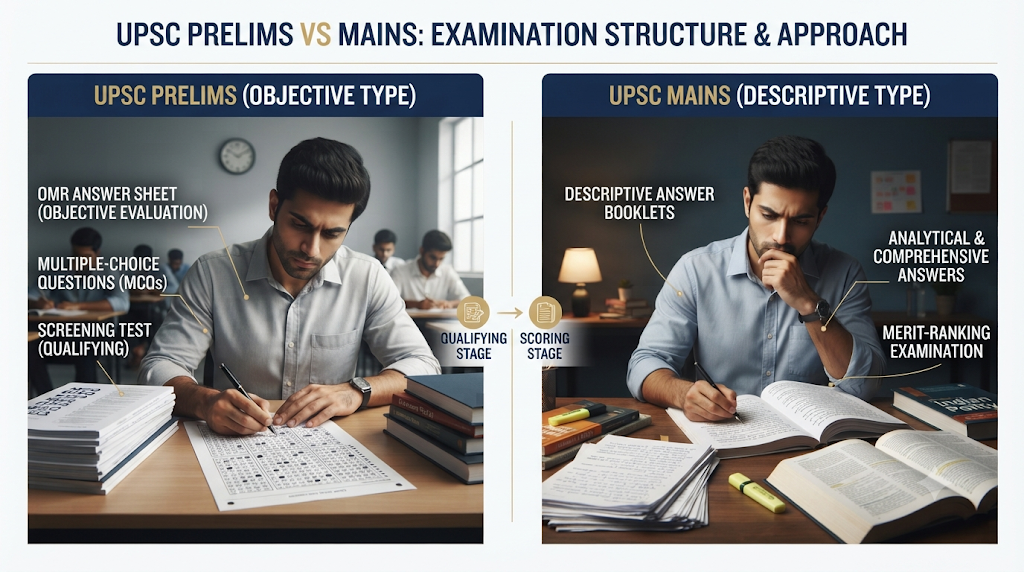
1. UPSC Prelims vs Mains: Exam Pattern, Structure and Key Differences
Before starting preparation, it is essential to understand how the UPSC Civil Services Examination is organised. The examination consists of three successive stages:
-
Civil Services Preliminary Examination (Prelims).
-
Civil Services Main Examination (Mains – Written Examination).
-
Personality Test (Interview).
Each stage has a different purpose, and candidates must qualify for the next stage according to the prescribed rules.
What Is UPSC Prelims?
The UPSC Preliminary Examination is the first stage of the Civil Services Examination. It acts as a screening test to shortlist candidates for the Mains examination.
Prelims consists of two compulsory objective-type papers:
-
General Studies Paper I (GS-I).
-
General Studies Paper II (CSAT).
Both papers carry 200 marks and have a duration of two hours each.
UPSC Prelims Exam Pattern
| Particulars | General Studies Paper I | CSAT Paper II |
|---|---|---|
| Total marks | 200 | 200 |
| Duration | 2 hours | 2 hours |
| Question type | Multiple-choice questions | Multiple-choice questions |
| Nature | Merit-based screening | Qualifying |
| Minimum qualifying marks | No fixed qualifying percentage | 33% |
| Negative marking | Applicable | Applicable |
The marks obtained in General Studies Paper I determine the candidate’s performance for the Prelims cutoff, subject to qualifying CSAT.
CSAT requires candidates to secure at least 33% marks, equivalent to 66.67 out of 200. Candidates must qualify in both papers according to the examination rules.
An important point is that Prelims marks are not included in the final merit ranking. Prelims is only a screening stage. Its purpose is to determine which candidates can appear in the Mains examination.
What Is UPSC Mains?
The UPSC Main Examination is the second stage of the Civil Services Examination. Unlike Prelims, it consists of descriptive, conventional essay-type papers.
Candidates are required to write structured answers that demonstrate their understanding of subjects, ability to analyse issues and capacity to communicate ideas effectively.
The written examination consists of nine papers:
-
Two qualifying language papers.
-
One Essay paper.
-
Four General Studies papers.
-
Two Optional Subject papers.
UPSC Mains Exam Pattern
| Paper | Subject | Marks | Nature |
|---|---|---|---|
| Paper A | Indian Language | 300 | Qualifying |
| Paper B | English | 300 | Qualifying |
| Paper I | Essay | 250 | Merit |
| Paper II | General Studies I | 250 | Merit |
| Paper III | General Studies II | 250 | Merit |
| Paper IV | General Studies III | 250 | Merit |
| Paper V | General Studies IV | 250 | Merit |
| Paper VI | Optional Subject Paper I | 250 | Merit |
| Paper VII | Optional Subject Paper II | 250 | Merit |
| Total written merit marks | 1,750 | ||
| Personality Test | Interview | 275 | Merit |
| Grand Total | 2,025 |
The two language papers are qualifying in nature and their marks are not included in the final merit calculation. Candidates must satisfy the prescribed qualifying standards.
The seven merit papers carry 1,750 marks, while the Personality Test carries 275 marks.
The final ranking is determined by combining the marks obtained in the Mains merit papers and the Personality Test.
Major Differences Between UPSC Prelims and Mains
Understanding the difference between the two stages helps aspirants select appropriate study methods.
| Basis of Comparison | UPSC Prelims | UPSC Mains |
|---|---|---|
| Examination type | Objective | Descriptive |
| Question format | MCQs | Written answers |
| Main purpose | Screening candidates | Evaluating merit |
| Number of papers | 2 | 9 |
| Main subjects | GS-I and CSAT | Essay, GS-I to GS-IV, Optional and language papers |
| Duration | 2 hours per paper | 3 hours per paper |
| Knowledge requirement | Conceptual clarity and factual awareness | Detailed understanding and analytical ability |
| Answer presentation | Selecting the correct option | Writing structured answers |
| Current affairs | Facts, events and concepts | Analysis, causes, impacts and solutions |
| Negative marking | Applicable | Not applicable in the same MCQ format |
| Contribution to final merit | Not counted | Counted for merit, except qualifying papers |
Why Is This Difference Important?
Imagine you are studying the topic of climate change.
For Prelims, you may need to understand:
-
Greenhouse gases.
-
International climate agreements.
-
Carbon markets.
-
Nationally Determined Contributions (NDCs).
-
Climate-related government initiatives.
-
Environmental conventions and organisations.
For Mains, the same topic requires a deeper understanding:
-
Causes and consequences of climate change.
-
Impact on Indian agriculture and vulnerable communities.
-
Climate finance and international cooperation.
-
India’s energy transition.
-
Adaptation and mitigation strategies.
-
Challenges in implementing climate policies.
The subject remains the same, but the way you use your knowledge changes.
This is why UPSC preparation should focus on developing both factual understanding and analytical thinking from the beginning.
2. UPSC Prelims and Mains Syllabus: Understanding GS-I, CSAT and Four General Studies Papers
The UPSC syllabus is extensive, but it becomes manageable when divided into smaller subjects and connected topics. Aspirants should understand the complete syllabus before selecting books, preparing notes or creating a study timetable.
A common mistake is studying random topics without checking their relevance to the official UPSC syllabus. This can waste valuable preparation time.
Let’s understand the syllabus of both stages.
UPSC General Studies Paper I (GS-I) Syllabus
General Studies Paper I is the most important paper in Prelims because its marks determine whether a candidate clears the screening examination.
It covers a wide range of subjects, including history, geography, polity, economy, environment, science and technology, and current affairs.
The major syllabus areas include:
1. Current Events of National and International Importance
Candidates should remain updated about important national and international developments.
Important areas include:
-
Government schemes and policies.
-
International relations and diplomatic developments.
-
Important national appointments and reports.
-
International organisations.
-
Economic developments.
-
Science and technology advancements.
-
Environmental developments.
-
Important awards and events.
Rather than memorising every newspaper article, focus on events that have a direct connection with the UPSC syllabus.
2. History of India and Indian National Movement
History is an important component of General Studies Paper I.
Major areas include:
-
Ancient Indian history.
-
Medieval Indian history.
-
Modern Indian history.
-
Indian freedom struggle.
-
Social and religious reform movements.
-
Important personalities and historical events.
-
Cultural developments and heritage.
Modern Indian history and the Indian National Movement deserve particular attention because they are frequently relevant to both Prelims and Mains.
3. Indian and World Geography
Geography tests conceptual understanding of physical, human and economic geographical processes.
Important topics include:
-
Physical geography.
-
Indian geography.
-
World geography.
-
Climate and weather systems.
-
Rivers and drainage systems.
-
Soil and vegetation.
-
Agriculture and natural resources.
-
Population distribution.
-
Industrial and economic geography.
-
Important geographical locations.
Map-based preparation is particularly useful for locations appearing in current affairs.
4. Indian Polity and Governance
Polity is an important area for both Prelims and Mains.
Topics include:
-
Indian Constitution.
-
Fundamental Rights.
-
Directive Principles of State Policy.
-
Fundamental Duties.
-
Parliament and State Legislatures.
-
President and Governor.
-
Supreme Court and High Courts.
-
Constitutional and statutory bodies.
-
Panchayati Raj institutions.
-
Local government.
-
Constitutional amendments.
5. Economic and Social Development
Candidates should understand the basic concepts of the Indian economy and important economic developments.
Major topics include:
-
Economic growth and development.
-
Poverty and unemployment.
-
Inclusive growth.
-
Government budgeting.
-
Banking and monetary policy.
-
Fiscal policy.
-
Inflation.
-
Financial inclusion.
-
Sustainable development.
-
Social sector initiatives.
6. Environment and Ecology
Environmental studies cover both static concepts and current developments.
Important areas include:
-
Biodiversity.
-
Ecosystems.
-
Conservation initiatives.
-
National parks and wildlife sanctuaries.
-
Climate change.
-
Environmental pollution.
-
Renewable energy.
-
International environmental conventions.
-
Endangered species.
-
Environmental legislation.
7. General Science and Science and Technology
This section evaluates basic scientific awareness and developments relevant to society.
Topics include:
-
Biotechnology.
-
Space technology.
-
Artificial intelligence.
-
Information technology.
-
Nanotechnology.
-
Health and diseases.
-
Defence technology.
-
Scientific discoveries and innovations.
UPSC CSAT (GS Paper II) Syllabus
CSAT, officially known as General Studies Paper II, is a qualifying paper in UPSC Prelims.
Although its marks do not determine the Prelims merit cutoff, candidates must secure at least 33% marks to qualify.
The syllabus includes:
1. Reading Comprehension
Candidates must understand passages, identify the central idea, interpret statements and select logically correct answers.
2. Logical Reasoning and Analytical Ability
Important topics include:
-
Logical sequences.
-
Statements and conclusions.
-
Assumptions and arguments.
-
Syllogisms.
-
Analytical reasoning.
-
Decision-making.
-
Problem-solving.
3. Basic Numeracy
The syllabus includes mathematics up to Class X level.
Important topics include:
-
Number systems.
-
Percentages.
-
Ratio and proportion.
-
Profit and loss.
-
Average.
-
Time and work.
-
Time, speed and distance.
-
Simple and compound interest.
-
Data interpretation.
4. Data Interpretation
Candidates should practise questions involving:
-
Tables.
-
Graphs.
-
Charts.
-
Data analysis.
-
Numerical comparisons.
5. General Mental Ability
This section tests logical thinking, numerical understanding and the ability to solve problems efficiently.
Preparation Tip: Do not ignore CSAT because it is qualifying. Many candidates focus heavily on GS-I and postpone CSAT practice until the final weeks. This can become risky, especially for aspirants who are not comfortable with mathematics or comprehension.
Solve previous-year CSAT papers early to understand your strengths and weaknesses.

UPSC Mains General Studies Papers: GS-I, GS-II, GS-III and GS-IV
The Mains General Studies syllabus is designed to evaluate a candidate’s understanding of Indian society, governance, economy, international relations, technology, environment, security and ethics.
Each paper carries 250 marks.
General Studies Paper I (GS-I): Indian Heritage, History, Geography and Society
GS-I focuses on India’s historical development, cultural heritage, geographical features and social structure.
Important topics include:
-
Indian culture, architecture and literature.
-
Ancient, medieval and modern Indian history.
-
Modern Indian history from the eighteenth century onwards.
-
Indian freedom struggle.
-
Post-independence consolidation and reorganisation.
-
World history.
-
Indian society and diversity.
-
Women-related issues.
-
Population and urbanisation.
-
Poverty and developmental challenges.
-
Globalisation and its impact on Indian society.
-
Communalism, regionalism and secularism.
-
Physical geography of the world.
-
Distribution of natural resources.
-
Geophysical phenomena.
For example, while studying urbanisation, do not limit your preparation to definitions. Understand migration, urban poverty, infrastructure shortages, waste management and sustainable urban planning.
This approach will help you write more analytical answers.
General Studies Paper II (GS-II): Polity, Governance, Social Justice and International Relations
GS-II examines the functioning of India’s political and administrative systems.
Important areas include:
-
Indian Constitution and constitutional framework.
-
Federal structure and Centre-State relations.
-
Separation of powers.
-
Parliament and State Legislatures.
-
Judiciary and judicial review.
-
Constitutional bodies.
-
Statutory, regulatory and quasi-judicial bodies.
-
Government policies and interventions.
-
Welfare schemes.
-
Issues related to health and education.
-
Poverty and hunger.
-
Transparency and accountability.
-
E-governance.
-
Civil services and governance.
-
India and its neighbourhood.
-
International institutions and bilateral relations.
For instance, when studying parliamentary functioning, connect constitutional provisions with contemporary issues such as legislative productivity, parliamentary committees and accountability mechanisms.
This creates a stronger foundation for Mains answer writing.
General Studies Paper III (GS-III): Economy, Science, Environment, Security and Disaster Management
GS-III focuses on economic development, technological advancements and important challenges facing the country.
Important topics include:
-
Indian economy and planning.
-
Inclusive growth.
-
Government budgeting.
-
Agriculture and irrigation.
-
Agricultural marketing.
-
Food processing.
-
Land reforms.
-
Infrastructure.
-
Investment models.
-
Science and technology.
-
Biotechnology and artificial intelligence.
-
Environmental conservation.
-
Biodiversity and climate change.
-
Disaster management.
-
Internal security.
-
Cybersecurity.
-
Border management.
-
Organised crime and terrorism.
For example, when preparing agriculture, understand issues such as minimum support prices, agricultural marketing, irrigation, crop diversification, farmer income and food security.
A balanced answer should explain the problem, identify its causes, discuss government initiatives and recommend practical solutions.
General Studies Paper IV (GS-IV): Ethics, Integrity and Aptitude
GS-IV is different from the other General Studies papers because it focuses on ethical understanding and practical application.
It evaluates a candidate’s moral reasoning, integrity, impartiality and ability to handle administrative situations.
Important topics include:
-
Ethics and human values.
-
Attitude.
-
Aptitude and foundational values.
-
Emotional intelligence.
-
Contributions of moral thinkers and philosophers.
-
Public service values.
-
Integrity and impartiality.
-
Objectivity.
-
Empathy and compassion.
-
Accountability.
-
Transparency.
-
Ethical governance.
-
Probity in public life.
-
Code of ethics and conduct.
-
Corruption and challenges in administration.
-
Case studies.
Case studies are particularly important.
For example, imagine an officer discovers corruption in a public welfare scheme. The officer must balance legal responsibilities, administrative pressure, public interest and the protection of vulnerable beneficiaries.
A good answer should identify stakeholders, ethical dilemmas, available options, possible consequences and the most appropriate course of action.

Importance of the Optional Subject in UPSC Mains
The Optional Subject is another important component of the Mains examination.
Candidates select one optional subject from the list prescribed by UPSC. It consists of two papers, each carrying 250 marks.
Together, these papers account for 500 marks out of the 1,750 written merit marks.
Some popular optional subjects include:
-
Geography.
-
Sociology.
-
History.
-
Political Science and International Relations (PSIR).
-
Public Administration.
-
Anthropology.
-
Philosophy.
-
Psychology.
-
Mathematics.
-
Literature subjects.
There is no universally best optional subject. The right choice depends on your interest, academic background, understanding of the syllabus, availability of study material and comfort with the subject.
How to Prepare an Optional Subject Effectively
-
Read the complete optional syllabus before selecting the subject.
-
Analyse at least five to ten years of previous-year questions.
-
Identify recurring themes and frequently tested areas.
-
Select limited and reliable study resources.
-
Prepare topic-wise notes.
-
Practise answer writing regularly.
-
Revise the syllabus multiple times.
-
Attempt sectional and full-length mock tests.
Avoid selecting an optional subject only because someone has scored high marks in it. Your own interest and ability to understand the subject are more important.
3. Integrated UPSC Prelims and Mains Preparation Strategy
One of the most effective ways to prepare for UPSC is to follow an integrated preparation strategy.
Integrated preparation means studying common subjects in a way that supports both Prelims and Mains rather than treating them as completely separate examinations.
For example, while studying the Indian Constitution, you should prepare constitutional articles, schedules, amendments and important provisions for Prelims. At the same time, understand constitutional values, governance challenges and institutional functioning for Mains.
This method saves time, improves conceptual clarity and reduces the pressure of completing the entire syllabus again after Prelims.
Step 1: Understand the UPSC Syllabus and Previous-Year Questions
Before starting your preparation, download the latest official UPSC syllabus.
Divide the syllabus into manageable sections:
-
History.
-
Geography.
-
Polity.
-
Economy.
-
Environment.
-
Science and Technology.
-
International Relations.
-
Governance.
-
Ethics.
-
Optional Subject.
-
Current Affairs.
Next, analyse previous-year questions (PYQs).
Previous-year questions help you understand:
-
Frequently tested topics.
-
Question patterns.
-
Important syllabus areas.
-
Conceptual depth.
-
Changing examination trends.
-
The difference between Prelims and Mains questions.
For example, if you are studying fundamental rights, analyse how UPSC has framed questions around constitutional provisions in Prelims and constitutional interpretation in Mains.
This gives you a clearer idea of what to study and how deeply to study it.
Step 2: Build Strong Conceptual Foundations
Beginners should focus on understanding basic concepts before moving towards advanced reference material.
Useful foundational resources include:
-
NCERT textbooks for history, geography, economics and political science.
-
Indian Polity by M. Laxmikanth.
-
A standard modern Indian history reference.
-
Basic geography textbooks and an atlas.
-
Basic economy resources.
-
Government reports and official publications.
-
A reliable environment and ecology reference.
The objective is not to collect as many books as possible. It is to understand the syllabus using a limited number of reliable resources.
A common mistake among aspirants is continuously changing books and coaching materials. This creates fragmented knowledge and makes revision difficult.
Follow a simple principle: one primary source, one set of notes and repeated revision.
Step 3: Integrate Current Affairs with Static Syllabus
Current affairs play an important role in both Prelims and Mains.
However, reading current affairs without connecting them to static subjects can create unnecessary information overload.
A better method is to connect every important news event with the relevant syllabus topic.
For example:
| Current Affairs Issue | Static Syllabus Connection |
|---|---|
| Supreme Court judgment | Indian Constitution and Judiciary |
| New government scheme | Governance and Social Justice |
| Climate conference | Environment and International Relations |
| RBI monetary policy | Indian Economy and Banking |
| International conflict | International Relations and Security |
| Agricultural reform | Agriculture and Inclusive Growth |
| Artificial intelligence policy | Science and Technology and Governance |
Suppose you read about a new Supreme Court judgment related to fundamental rights.
Instead of simply making a note about the judgment, understand the constitutional article involved, the legal background, its implications and its relevance to governance.
For Prelims, note important factual information. For Mains, prepare the issue’s background, challenges, consequences and possible solutions.
This approach makes current affairs preparation more meaningful and manageable.
Step 4: Prepare Notes for Both Examinations
Effective note-making is an important part of integrated preparation.
Your notes should be concise, organised and easy to revise.
You can maintain separate sections for:
Prelims Notes
-
Important facts.
-
Constitutional articles.
-
Government schemes.
-
Reports and indices.
-
Important organisations.
-
National parks and species.
-
Historical events.
-
Economic terminology.
-
Scientific developments.
Mains Notes
-
Background of an issue.
-
Causes and consequences.
-
Advantages and disadvantages.
-
Government initiatives.
-
Challenges and limitations.
-
Constitutional and legal dimensions.
-
Committee recommendations.
-
Relevant examples.
-
Practical solutions.
For example, while preparing notes on unemployment, your Prelims notes may cover unemployment indicators, labour force participation and relevant government schemes.
Your Mains notes should additionally include structural causes, skill gaps, informal employment, gender-related challenges and policy recommendations.
Step 5: Develop Separate Practice Methods for Prelims and Mains
Although the subjects overlap, the practice methods should be different.
For Prelims, focus on:
-
Daily MCQ practice.
-
Conceptual elimination.
-
Accuracy improvement.
-
Time management.
-
CSAT practice.
-
Mock tests.
-
Revision of factual information.
For Mains, focus on:
-
Answer writing.
-
Essay practice.
-
Analytical thinking.
-
Case studies.
-
Structuring arguments.
-
Using examples and relevant data.
-
Time management.
A practical weekly routine can include five days of concept-based study, daily MCQ practice, three to four Mains answers on selected days and one dedicated revision session.
The exact schedule should depend on your preparation stage and available study hours.
Step 6: Revise Regularly Instead of Continuously Collecting Material
Revision is one of the most underestimated parts of UPSC preparation.
Reading a chapter once does not guarantee that you will remember it during the examination.
A simple revision cycle can be:
-
First revision: Within 24 hours.
-
Second revision: After 7 days.
-
Third revision: After 30 days.
-
Fourth revision: During full syllabus revision.
The intervals can be adjusted according to the subject and your retention level.
For difficult subjects such as economy, geography and environment, make short revision sheets containing definitions, diagrams, facts and important concepts.
4. UPSC Prelims MCQ Solving Techniques and Mains Answer Writing Practice
Knowing the syllabus is only one part of preparation. The next challenge is learning how to perform effectively in the examination.
Prelims requires accurate decision-making under time pressure, while Mains requires clear and structured communication.
Both skills improve through consistent practice.
UPSC Prelims MCQ Solving Techniques
Prelims is not simply a test of how many facts you remember. It also evaluates your ability to interpret questions, identify incorrect statements and eliminate doubtful options.
The following techniques can improve your performance.
1. Read Every Question Carefully
Pay attention to words such as:
-
Only.
-
All.
-
None.
-
Correct.
-
Incorrect.
-
Not correct.
-
With reference to.
-
Consider the following statements.
A small word can change the meaning of the entire question.
2. Use Intelligent Elimination
Intelligent elimination means removing clearly incorrect options using conceptual knowledge and logical reasoning.
For example, suppose a question contains four statements about the Indian Constitution.
You may not remember every detail, but you might identify that one statement incorrectly describes the powers of a constitutional authority.
Eliminating that statement can help narrow down the possible answers.
However, elimination should be based on sound reasoning rather than unsupported assumptions.
3. Understand Negative Marking
UPSC Prelims applies negative marking for incorrect answers.
For objective questions carrying equal marks, the standard scheme deducts one-third of the marks assigned to a question for an incorrect response. There is no penalty for leaving a question unanswered.
This makes accuracy an important part of preparation.
Avoid blindly guessing answers. At the same time, do not leave every unfamiliar question unanswered without considering whether you can eliminate some options logically.
4. Practise Time Management
A two-hour paper requires disciplined time management.
A practical approach is:
-
First round: Solve questions you understand confidently.
-
Second round: Attempt questions requiring additional analysis.
-
Third round: Review doubtful questions and check for careless mistakes.
Do not spend too much time on a single difficult question.
5. Maintain an MCQ Mistake Notebook
After every mock test, record:
-
Incorrect answers.
-
Questions you guessed correctly.
-
Concepts you misunderstood.
-
Topics you repeatedly forget.
-
Questions where you spent too much time.
Review this notebook regularly. It helps identify recurring weaknesses that ordinary revision may not reveal.

UPSC Mains Answer Writing Practice: 150-Word and 250-Word Answers
Mains answer writing is a skill that needs regular development.
Aspirants often understand a topic but struggle to express their knowledge within the prescribed word limit and time.
A good answer is not necessarily the longest answer. It is one that addresses the question directly, presents relevant arguments and reaches a logical conclusion.
Understanding 150-Word Answers
A 150-word answer generally requires a concise and focused discussion.
A useful structure is:
-
Introduction: Approximately 20–25 words.
-
Main body: Approximately 95–105 words.
-
Conclusion: Approximately 20–25 words.
For example, consider the question:
“Discuss the importance of local self-government in strengthening democracy in India.”
Your introduction can briefly explain the role of local governance.
The main body can discuss democratic participation, decentralisation, accountability, local development and challenges such as inadequate funds and administrative capacity.
The conclusion can suggest strengthening the financial and institutional autonomy of local bodies.
Understanding 250-Word Answers
A 250-word answer allows greater scope for detailed analysis.
A useful structure is:
-
Introduction: Approximately 30–40 words.
-
Main body: Approximately 170–180 words.
-
Conclusion: Approximately 30–40 words.
For example:
“Examine the challenges faced by India in achieving inclusive economic growth.”
A strong answer may discuss:
-
Regional economic inequality.
-
Unemployment and underemployment.
-
Rural-urban disparities.
-
Gender inequality.
-
Educational and skill gaps.
-
Financial exclusion.
-
Social protection.
-
Government initiatives.
-
Policy reforms and recommendations.
The objective is to address all important dimensions without repeating the same arguments.
A Practical Answer-Writing Framework
You can use the following structure for most General Studies questions:
Introduction: Define the concept, provide relevant context or refer to a constitutional provision.
Main Body: Discuss the issue through relevant dimensions such as political, economic, social, administrative, environmental or ethical perspectives.
Challenges: Explain implementation gaps, limitations and practical difficulties.
Way Forward: Suggest realistic reforms, policy improvements and institutional measures.
Conclusion: End with a balanced and constructive statement.
Understand the Question’s Directive Words
One of the most important answer-writing skills is understanding what the question actually demands.
| Directive | What You Should Do |
|---|---|
| Discuss | Present different aspects of the topic |
| Examine | Analyse the issue in detail |
| Critically Analyse | Evaluate both strengths and weaknesses |
| Evaluate | Assess the effectiveness or significance |
| Explain | Clarify the concept with relevant details |
| Comment | Present a reasoned opinion |
| Analyse | Break the issue into different components |
| Elucidate | Explain with examples and supporting details |
For example, if the question says “Critically examine”, merely listing advantages is insufficient. You must also discuss limitations and present a balanced assessment.
Improve Presentation Through Diagrams, Flowcharts and Examples
Visual presentation can make an answer easier to understand.
Use:
-
Flowcharts for processes.
-
Tables for comparisons.
-
Maps for geographical topics.
-
Diagrams for scientific and environmental concepts.
-
Relevant constitutional articles for polity.
-
Case studies and examples for ethics.
However, diagrams should add value rather than simply decorate the answer.
A well-structured answer with relevant content is more important than unnecessary visual elements.
5. UPSC Previous-Year Questions, Mock Tests, Revision Techniques and Preparation Timeline
Aspirants often spend months studying books but do not practise enough questions. This creates a gap between theoretical knowledge and examination performance.
Previous-year questions and mock tests help bridge this gap.
Importance of UPSC Previous-Year Questions (PYQs)
Previous-year questions provide valuable insight into how UPSC tests different subjects.
They help aspirants identify:
-
Important syllabus areas.
-
Repeated concepts.
-
Question difficulty.
-
Changing examination trends.
-
Common conceptual traps.
-
The level of analytical depth required.
How to Use PYQs Effectively
Do not simply solve questions and check the answers.
Follow a structured process:
-
Select a subject or syllabus topic.
-
Collect relevant Prelims and Mains PYQs.
-
Solve the questions without looking at the answers.
-
Analyse the correct and incorrect options.
-
Identify the concepts behind each question.
-
Update your notes with important learning points.
-
Revise the topic and attempt similar questions again.
For example, while studying Parliament, analyse questions related to legislative procedures, parliamentary committees, privileges and constitutional provisions.
Then examine Mains questions on parliamentary accountability and the functioning of legislative institutions.
This helps you develop a topic from both examination perspectives.
Role of Mock Tests in UPSC Preparation
Mock tests are essential for understanding your preparation level.
However, taking multiple tests without analysing mistakes is not an effective strategy.
Prelims Mock Test Strategy
Initially, attempt subject-wise tests after completing individual topics.
As your preparation progresses, start taking full-length tests covering the complete syllabus.
Focus on:
-
Accuracy.
-
Time management.
-
Question selection.
-
Elimination techniques.
-
Negative marking.
-
Performance consistency.
After each test, spend sufficient time analysing your performance.
A candidate scoring 90 marks who carefully analyses mistakes may improve faster than someone taking several tests without reviewing them.
Mains Mock Test Strategy
For Mains, practise writing answers within the prescribed time.
Focus on:
-
Understanding the question.
-
Following the word limit.
-
Writing relevant introductions.
-
Structuring the main body.
-
Including examples and data where appropriate.
-
Providing balanced conclusions.
-
Completing the paper on time.
Attempt sectional tests before moving to full-length Mains tests.
Revision Techniques for Better Retention
UPSC preparation involves a large syllabus, so revision should be planned from the beginning.
Here are some useful methods.
1. Active Recall
Instead of repeatedly reading the same chapter, close the book and try to recall important concepts.
For example, after studying Fundamental Rights, write down the relevant articles and explain their meaning without referring to your notes.
2. Spaced Repetition
Revise important topics at gradually increasing intervals.
This helps strengthen long-term memory.
3. Short Revision Notes
Prepare concise notes for:
-
Constitutional articles.
-
Historical timelines.
-
Important economic concepts.
-
Government schemes.
-
Environmental conventions.
-
Important reports.
-
Mains examples and case studies.
4. Topic-Wise Revision
Divide subjects into smaller units.
For example, instead of revising the entire economy in one day, revise monetary policy, fiscal policy, banking, inflation and external trade separately.
5. Weekly Revision Tests
At the end of every week, attempt a short test covering the topics studied during that week.
This helps evaluate retention and identify topics requiring additional attention.
UPSC Prelims to Mains Preparation Timeline
One of the biggest challenges for UPSC aspirants is managing the transition from Prelims to Mains.
The examination stages are connected, but their preparation requirements change as the examination approaches.
A well-planned timeline helps aspirants balance syllabus coverage, revision, answer writing and mock tests.
The following is an illustrative 12-month preparation plan. It should be adjusted according to the official examination calendar and the candidate’s preparation level.
Phase 1: Months 1–3 – Foundation Building
Primary objective: Develop conceptual clarity and understand the syllabus.
Activities:
-
Read the official UPSC syllabus.
-
Analyse previous-year questions.
-
Complete basic NCERT textbooks.
-
Start standard books for polity, history and geography.
-
Understand basic economic concepts.
-
Read a reliable newspaper.
-
Begin preparing short notes.
-
Practise basic CSAT questions.
At this stage, focus on understanding rather than completing everything quickly.
Phase 2: Months 4–6 – Complete Core Subjects
Primary objective: Strengthen static preparation and begin integrated practice.
Activities:
-
Complete core General Studies subjects.
-
Study environment and science and technology.
-
Begin optional subject preparation seriously.
-
Connect current affairs with static subjects.
-
Start daily Prelims MCQ practice.
-
Practise basic Mains answer writing.
-
Analyse PYQs subject-wise.
-
Revise completed subjects.
By the end of this phase, you should have a clear understanding of the major syllabus areas.
Phase 3: Months 7–8 – Integrated Preparation and Consolidation
Primary objective: Improve conceptual application and answer-writing ability.
Activities:
-
Revise standard books.
-
Prepare topic-wise current affairs notes.
-
Complete a substantial portion of the optional syllabus.
-
Practise Mains answers regularly.
-
Attempt subject-wise Prelims mock tests.
-
Begin sectional Mains tests.
-
Improve CSAT accuracy.
-
Identify weak areas.
At this stage, avoid collecting unnecessary new study materials.
Phase 4: Months 9–10 – Prelims-Focused Preparation
Primary objective: Improve accuracy, speed and factual retention.
Activities:
-
Revise the complete Prelims syllabus.
-
Attempt full-length GS-I mock tests.
-
Practise CSAT papers.
-
Solve previous-year Prelims questions.
-
Revise current affairs.
-
Strengthen weak subjects.
-
Maintain an MCQ mistake notebook.
-
Practise intelligent elimination.
As Prelims approaches, increase the proportion of time dedicated to objective question practice.
Phase 5: Months 11–12 – Final Revision and Examination Preparation
Primary objective: Consolidate preparation and improve examination performance.
Activities:
-
Complete multiple rounds of revision.
-
Attempt full-length mock tests.
-
Revise important facts and concepts.
-
Practise CSAT regularly.
-
Avoid unnecessary new resources.
-
Maintain a consistent sleep and study routine.
-
Focus on accuracy and confidence.
After Prelims, candidates should immediately shift towards Mains-focused preparation rather than waiting for the result.
The Post-Prelims Transition Strategy
The period between Prelims and Mains is particularly important.
Once Prelims is over, your preparation should become more focused on descriptive examination requirements.
Priorities should include:
-
Completing pending Optional Subject preparation.
-
Revising all four General Studies papers.
-
Practising 150-word and 250-word answers.
-
Attempting full-length Mains mock tests.
-
Preparing essay topics.
-
Practising Ethics case studies.
-
Revising current affairs and important examples.
-
Improving answer presentation and time management.
Aspirants should not waste the post-Prelims period waiting for the official result. Continue preparing for Mains because the time available for revision and answer-writing practice is limited.
Sample Daily Study Timetable for UPSC Aspirants
A daily timetable should be realistic and sustainable.
Here is an illustrative schedule for a full-time aspirant:
| Time | Activity |
|---|---|
| 6:00 AM – 7:00 AM | Newspaper and current affairs |
| 7:00 AM – 9:00 AM | Core GS subject |
| 9:00 AM – 10:00 AM | Breakfast and break |
| 10:00 AM – 12:00 PM | Standard books and concept building |
| 12:00 PM – 1:00 PM | Prelims MCQ practice |
| 1:00 PM – 2:00 PM | Lunch and rest |
| 2:00 PM – 4:00 PM | Optional Subject |
| 4:00 PM – 5:00 PM | Break |
| 5:00 PM – 6:00 PM | Mains answer writing |
| 6:00 PM – 7:00 PM | Revision |
| 7:00 PM onwards | Dinner, rest and light reading |
This is only a sample. Working professionals, college students and part-time aspirants can modify the timetable according to their availability.
Consistency is more valuable than following an unrealistic timetable for a few days.
Common Mistakes to Avoid During UPSC Preparation
Even hardworking aspirants sometimes make mistakes that affect their preparation.
Here are some common problems and how to avoid them.
1. Treating Prelims and Mains as Completely Separate Examinations
Studying the same subject twice without connecting the two stages increases preparation time.
Solution: Follow an integrated approach and prepare common concepts from both perspectives.
2. Ignoring CSAT
Candidates sometimes assume that CSAT is easy because it is qualifying.
Solution: Practise CSAT from the beginning, especially if you struggle with mathematics, comprehension or reasoning.
3. Collecting Too Many Books and Resources
Having more material does not automatically improve preparation.
Solution: Follow limited, reliable resources and revise them repeatedly.
4. Avoiding Answer Writing Until After Prelims
Candidates who postpone Mains preparation may struggle with answer structure and time management.
Solution: Practise a few answers regularly during the integrated preparation phase.
5. Reading Current Affairs Without Connecting Them to the Syllabus
Random news consumption creates information overload.
Solution: Connect important news with relevant static subjects and prepare short, syllabus-oriented notes.
6. Taking Mock Tests Without Analysing Them
Simply attempting tests does not guarantee improvement.
Solution: Analyse incorrect answers, identify knowledge gaps and revise weak areas.
7. Neglecting the Optional Subject
The optional subject contributes 500 marks to the written merit total.
Solution: Give it regular study time and practise both optional papers.
8. Ignoring Revision
Completing the syllabus without revising it can lead to poor retention.
Solution: Maintain weekly and monthly revision cycles.
9. Comparing Your Preparation with Other Aspirants
Every candidate has different academic backgrounds, strengths and learning speeds.
Solution: Track your own progress and focus on measurable improvement.
10. Following an Unbalanced Study Routine
Studying for excessively long hours without adequate rest can reduce concentration and consistency.
Solution: Build a sustainable timetable with proper breaks, sleep and regular revision.
Conclusion: Build an Integrated Strategy to Clear UPSC Prelims and Mains
The difference between UPSC Prelims and Mains is not limited to objective and descriptive questions. Both stages evaluate different dimensions of a candidate’s knowledge, understanding and examination skills.
Prelims tests conceptual clarity, factual awareness, analytical elimination and accuracy under time pressure. Mains evaluates deeper understanding, critical thinking, answer-writing ability, ethical reasoning and the capacity to present balanced arguments.
The most effective approach is to prepare for both stages through an integrated strategy.
Start by understanding the official UPSC syllabus and analysing previous-year questions. Build strong foundations in General Studies subjects, connect current affairs with static topics, select your optional subject carefully and practise both MCQs and descriptive answers regularly.
Remember these five important principles:
-
Understand the syllabus before starting preparation.
-
Build conceptual clarity instead of depending only on memorisation.
-
Integrate static subjects with current affairs.
-
Practise Prelims MCQs and Mains answer writing consistently.
-
Revise regularly and analyse every mock test.
Clearing UPSC is a long-term process that requires patience, discipline and strategic preparation. You do not need to study everything available on the internet. You need to study the right subjects, understand them properly, revise them repeatedly and apply your knowledge effectively.
Your UPSC preparation should not begin with the question, “How many hours should I study?” It should begin with, “How effectively am I preparing for both Prelims and Mains?”
Start with a clear plan, follow the syllabus, learn from previous-year questions and improve your performance every week. Consistent and focused preparation can make the challenging journey towards the Civil Services Examination more organised and achievable.
FAQs: UPSC Prelims vs Mains – Differences, Syllabus and Preparation Strategy
Basic Differences Between UPSC Prelims and Mains
1. What is the main difference between UPSC Prelims and Mains?
UPSC Prelims is an objective screening examination consisting of two papers: General Studies Paper I and CSAT. UPSC Mains is a descriptive examination consisting of nine papers, including Essay, four General Studies papers and two Optional Subject papers, along with two qualifying language papers.
2. Is UPSC Prelims easier than Mains?
Neither examination is universally easier. Prelims requires strong conceptual understanding, factual knowledge and accurate MCQ-solving skills. Mains requires analytical thinking, answer-writing ability, subject knowledge and effective time management.
3. How many papers are there in UPSC Prelims?
UPSC Prelims has two compulsory papers: General Studies Paper I and General Studies Paper II (CSAT). Both carry 200 marks and have a duration of two hours.
4. How many papers are there in UPSC Mains?
UPSC Mains consists of nine descriptive papers: two qualifying language papers, one Essay paper, four General Studies papers and two Optional Subject papers.
5. Are UPSC Prelims marks counted in the final merit list?
No. Prelims marks are used only for screening candidates for Mains. The final merit list is based on the marks obtained in the seven Mains merit papers and the Personality Test.
6. How many marks are required to qualify for UPSC Prelims?
There is no fixed qualifying percentage for General Studies Paper I. Candidates must score above the applicable category-wise cutoff and secure at least 33% in CSAT to qualify.
7. Is CSAT compulsory for UPSC Prelims?
Yes. CSAT is compulsory, and candidates must secure at least 33% marks. Although it is qualifying in nature, failing to qualify CSAT results in disqualification from Prelims.
8. How many marks are required in UPSC Mains?
The seven merit papers of UPSC Mains carry a total of 1,750 marks. Candidates must also qualify in the two language papers according to the prescribed standards.
9. Does UPSC Mains have negative marking?
No. The descriptive Mains examination does not have the objective-question negative marking system used in Prelims.
10. What is the total marks of the UPSC Civil Services Examination?
The final merit total is 2,025 marks, consisting of 1,750 marks from the Mains merit papers and 275 marks from the Personality Test.
UPSC Prelims and Mains Syllabus
11. What is included in the UPSC Prelims GS Paper I syllabus?
The syllabus includes current events, Indian history, the Indian National Movement, geography, Indian polity, governance, economy, social development, environment, ecology and general science.
12. What is the syllabus of UPSC CSAT Paper II?
CSAT covers reading comprehension, logical reasoning, analytical ability, decision-making, problem-solving, basic numeracy and data interpretation.
13. What are the four General Studies papers in UPSC Mains?
GS-I covers history, culture, society and geography. GS-II covers polity, governance, social justice and international relations. GS-III covers economy, science and technology, environment, security and disaster management. GS-IV covers ethics, integrity and aptitude.
14. What is the difference between GS Paper I in Prelims and GS-I in Mains?
Prelims GS-I tests objective knowledge across multiple subjects, whereas Mains GS-I focuses on descriptive analysis of Indian heritage, history, society and geography.
15. Is Indian Polity important for both Prelims and Mains?
Yes. Prelims focuses on constitutional provisions, institutions and factual understanding, while Mains requires analytical knowledge of governance, federalism, constitutional challenges and institutional functioning.
16. Is current affairs important for UPSC Prelims and Mains?
Yes. Current affairs are important for both stages. Prelims focuses on factual and conceptual awareness, whereas Mains requires analysis of causes, consequences, challenges and policy solutions.
17. Is NCERT necessary for UPSC preparation?
NCERT textbooks are useful for developing foundational understanding of subjects such as history, geography, economics and political science. They are particularly valuable for beginners.
18. Which subjects overlap between UPSC Prelims and Mains?
History, geography, polity, economy, environment, science and technology, and current affairs have significant overlap. However, the depth and method of preparation differ between the two stages.
19. Is the UPSC Mains syllabus more extensive than Prelims?
Mains has a broad descriptive syllabus covering several specialised areas, including ethics, governance, international relations, essay writing and an optional subject. Both stages require extensive preparation, but Mains demands greater analytical depth.
20. What is the importance of the UPSC Optional Subject?
The optional subject consists of two papers carrying 250 marks each, making a total of 500 marks. It contributes significantly to the Mains merit score.
UPSC Preparation Strategy
21. Can I prepare for UPSC Prelims and Mains together?
Yes. An integrated preparation strategy is recommended because many subjects overlap. Study common concepts together while practising MCQs for Prelims and descriptive answers for Mains.
22. When should I start preparing for UPSC Mains?
Ideally, Mains preparation should begin alongside Prelims preparation. Regular answer writing, optional subject preparation and syllabus-based note-making can reduce pressure after Prelims.
23. How many hours should I study daily for UPSC?
There is no fixed number of study hours required to clear UPSC. A consistent, focused timetable based on your preparation level and available time is more effective than following unrealistic study targets.
24. How should beginners start UPSC preparation?
Beginners should understand the official syllabus, analyse previous-year questions, study NCERT textbooks, select standard reference books, read a reliable newspaper and gradually begin MCQ practice and answer writing.
25. Which books are best for UPSC Prelims and Mains?
Commonly used resources include NCERT textbooks, M. Laxmikanth for Indian Polity, a standard modern history reference, geography textbooks and an atlas, economy resources and a reliable environment reference. The selection should be aligned with the official syllabus.
26. Is newspaper reading necessary for UPSC?
Newspaper reading helps candidates understand national and international developments, government policies, economic issues, judicial decisions and international relations. Focus on syllabus-relevant news rather than reading every article.
27. How can I prepare current affairs for both Prelims and Mains?
Connect important news with static syllabus topics. Make factual notes for Prelims and analytical notes covering background, causes, impacts, challenges and solutions for Mains.
28. How important are previous-year questions in UPSC preparation?
PYQs help candidates understand question patterns, recurring themes, syllabus coverage and examination expectations. Analysing them is more valuable than simply memorising their answers.
29. How many mock tests should I attempt for UPSC Prelims?
There is no fixed ideal number. Focus on completing a reasonable number of subject-wise and full-length tests, followed by detailed performance analysis and revision.
30. How can I improve my UPSC preparation strategy?
Follow the syllabus, use limited resources, revise regularly, practise PYQs, attempt mock tests, improve answer writing and analyse your weaknesses consistently.
UPSC Prelims MCQ and Mains Answer Writing
31. How can I improve accuracy in UPSC Prelims?
Improve conceptual understanding, practise previous-year questions, learn intelligent elimination, analyse mistakes and avoid unsupported guessing.
32. What is the elimination technique in UPSC Prelims?
Elimination is a method of removing incorrect options using conceptual knowledge, logical reasoning and careful interpretation of statements to improve the chances of selecting the correct answer.
33. How does negative marking work in UPSC Prelims?
For each incorrect objective answer, one-third of the marks assigned to that question are deducted. No marks are deducted for unanswered questions.
34. How many questions should I attempt in UPSC Prelims?
There is no universally correct number. The number of attempts should depend on your accuracy, knowledge, ability to eliminate options and risk management.
35. How do I start answer writing for UPSC Mains?
Start with previous-year questions and practise short answers. Focus on understanding directive words, writing relevant introductions, organising the main body and providing balanced conclusions.
36. What is the ideal structure of a UPSC Mains answer?
A good answer generally contains an introduction, a well-organised main body and a relevant conclusion. Use examples, constitutional provisions, data and diagrams wherever appropriate.
37. How should I write a 150-word UPSC answer?
Use a short introduction, a focused discussion covering the main dimensions of the question and a concise conclusion. Avoid unnecessary background information.
38. How should I write a 250-word UPSC answer?
Use the additional word limit to explain multiple dimensions, include relevant examples, examine challenges and suggest practical solutions before concluding.
39. Are diagrams important in UPSC Mains answer writing?
Diagrams, flowcharts, maps and tables can improve presentation when they explain a concept effectively. However, they should support relevant content rather than replace analysis.
40. How can I improve my UPSC Mains answer-writing speed?
Practise timed answers, improve handwriting readability, prepare structured notes, avoid unnecessary introductions and develop the ability to organise arguments quickly.
UPSC Revision and Examination Timeline
41. How many months are required to prepare for UPSC?
Preparation time varies according to educational background, available study hours and familiarity with the syllabus. Many aspirants follow a structured preparation plan of 12–18 months, although individual requirements differ.
42. What is the best revision strategy for UPSC?
Use active recall, spaced repetition, short notes, topic-wise revision and weekly tests. Revise standard sources multiple times rather than continuously collecting new material.
43. What should I do immediately after UPSC Prelims?
Shift towards Mains preparation by revising GS papers, completing optional subject preparation, practising answer writing, preparing essays and attempting full-length Mains tests.
44. How much time is available between UPSC Prelims and Mains?
The exact gap depends on the official examination calendar. Aspirants should check the relevant annual notification and prepare for Mains without waiting for the Prelims result.
45. Should I continue studying my optional subject during Prelims preparation?
Yes. Maintaining regular optional subject preparation helps prevent syllabus backlogs and reduces pressure during the post-Prelims period.
46. Can working professionals prepare for UPSC?
Yes. Working professionals can prepare through a realistic timetable, focused study sessions, weekend revision, current affairs preparation and regular practice tests.
47. Is coaching necessary to clear UPSC Prelims and Mains?
No. Coaching is not compulsory. Candidates can prepare through self-study using standard books, official resources, PYQs, mock tests and structured revision.
48. What are the most common mistakes in UPSC preparation?
Common mistakes include ignoring CSAT, avoiding answer writing, collecting excessive resources, neglecting optional subjects, skipping revision and taking mock tests without analysing mistakes.
49. Which is more important: Prelims or Mains?
Both are essential. Prelims determines eligibility for Mains, while Mains and the Personality Test determine the final merit ranking. Candidates should prepare strategically for both stages.
50. What is the most effective strategy to clear UPSC in the first attempt?
Understand the syllabus, analyse PYQs, build strong fundamentals, follow integrated preparation, select an appropriate optional subject, practise MCQs and answer writing, revise consistently and maintain a sustainable study routine. No strategy can guarantee selection, but disciplined preparation improves readiness.
Also Read: Government Jobs Without Competitive Exams in India
